
Advancing Global Cellular Coverage with Advanced Antenna Array
Jun 24, 2026
AST SpaceMobile Inc. has successfully launched three BlueBird satellites into low Earth orbit, bringing its plans to provide cellular broadband directly to standard smartphones one step closer. The rocket lifted off from Cape Canaveral Space Force Station aboard a Falcon 9 in the firm’s first stacked configuration. The mission is part of AST SpaceMobile’s plan to increase its constellation of satellites in orbit to offer cellular coverage without the need for specialized equipment or ground antennas. The success demonstrates AST SpaceMobile’s vision of creating a space based cellular network that complements current mobile networks and provides connectivity in various regions around the world.
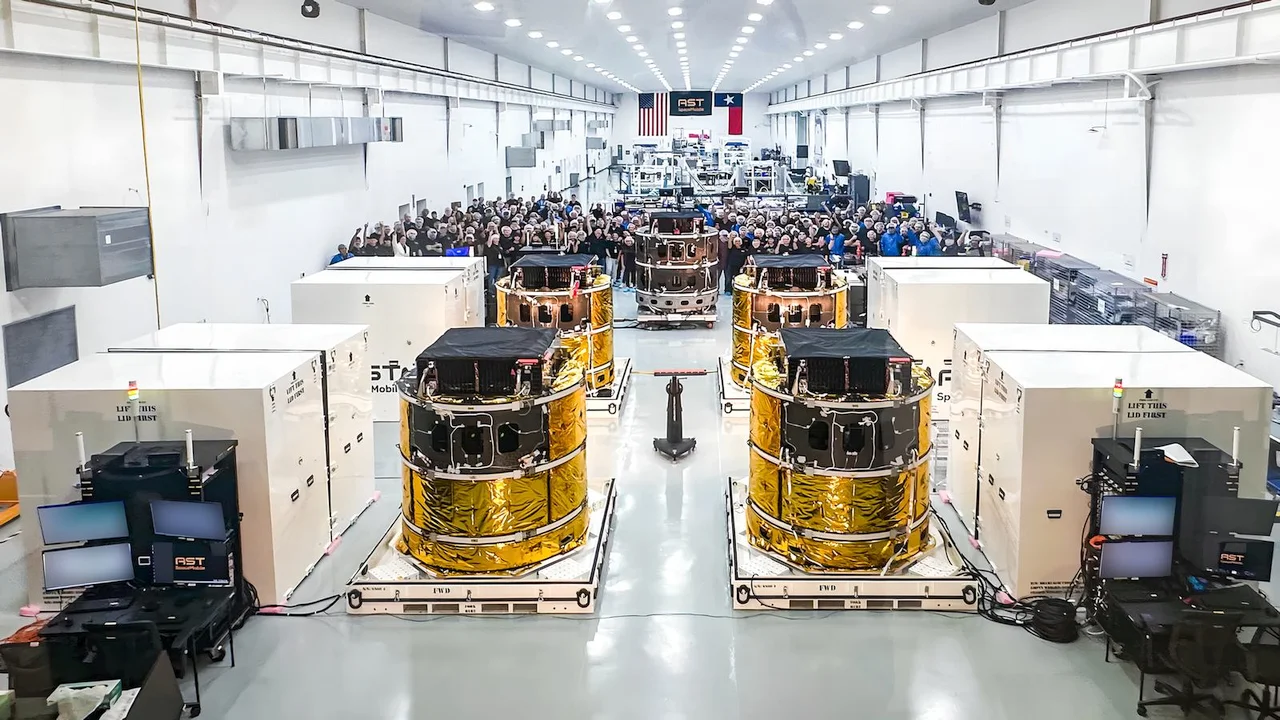 Final stage of construction for five BlueBird satellites. Credit: AST SpaceMobile
The antenna arrays on the BlueBird satellites are about 223 square meters when extended in orbit. These antenna structures are the largest commercial communication arrays to date in low Earth orbit. The large surface area provides a number of functions required for satellite operations at orbital distance. The design features solar energy capture systems to ensure consistent performance of data transmission. The physics of communicating with low power mobile devices from hundreds of miles away necessitated engineering solutions that AST SpaceMobile has developed with its antenna and transmission system design.
When sent directly to standard smartphones, data transmission speeds are about 200 megabits per second, twice the speed of its previous Block 1 BlueBird satellites. The system supports voice calls, web browsing and video streaming applications from space. Targeted beam coverage focuses cellular frequencies in specific geographic areas to maximize signal strength in each area. The antenna design helps to minimize signal interference and allows the platform to provide capacity similar to terrestrial networks. This addresses one of the main challenges in satellite communications, which is providing useful data rates to unmodified consumer devices.
AST SpaceMobile said the deployment is a fulfillment of its commercial expansion plans. Leadership noted that BlueBirds 8, 9 and 10 are further proof of the development of space based cellular broadband capabilities. The expansion is intended to fill a void in the market for millions of users in underserved areas around the world, and is driven by the confidence that market demand will support it. The Texas based company is ramping up manufacturing and launch activities, with BlueBirds 11, 12 and 13 in the final stages of preparation for shipping to Florida. Its 500,000 square foot facility in Midland, Texas is currently manufacturing additional spacecraft through BlueBird 37. The production schedule shows AST SpaceMobile’s plans for expanding orbital capacity during the next operational period.
The market position of AST SpaceMobile is indicative of the increasing demand from terrestrial mobile operators for universal coverage for their subscribers. The firm is relying on partnerships with global telecom operators to connect its satellite network with existing 4G and 5G networks. AST SpaceMobile has over 3,900 patents and patent pending claims in its IP portfolio. The U.S. Federal Communications Commission has approved commercial use of the space based broadband network for nationwide deployment. As the satellite communications industry evolves and grows globally, these regulatory clearances and partnerships position AST SpaceMobile as a key player in the new direct to cell satellite communications market.