
Telesat’s Delay Underscores the Stakes in LEO Sovereignty Race
Mar 19, 2026
In March 2026, Dan Goldberg stood before Telesat’s investors and delivered the kind of news that no CEO enjoys giving. The Lightspeed Low-Earth Orbit constellation — Canada’s most ambitious space infrastructure project in a generation — would not enter service at the end of 2027 as planned. The new target was the first quarter of 2028. The culprit was a single component: an application-specific integrated circuit, an ASIC, the chip that powers the satellites’ onboard processors. Goldberg was direct about it, telling investors that these chips had been one of the key schedule risks on the program all along — and that risk had now materialized.
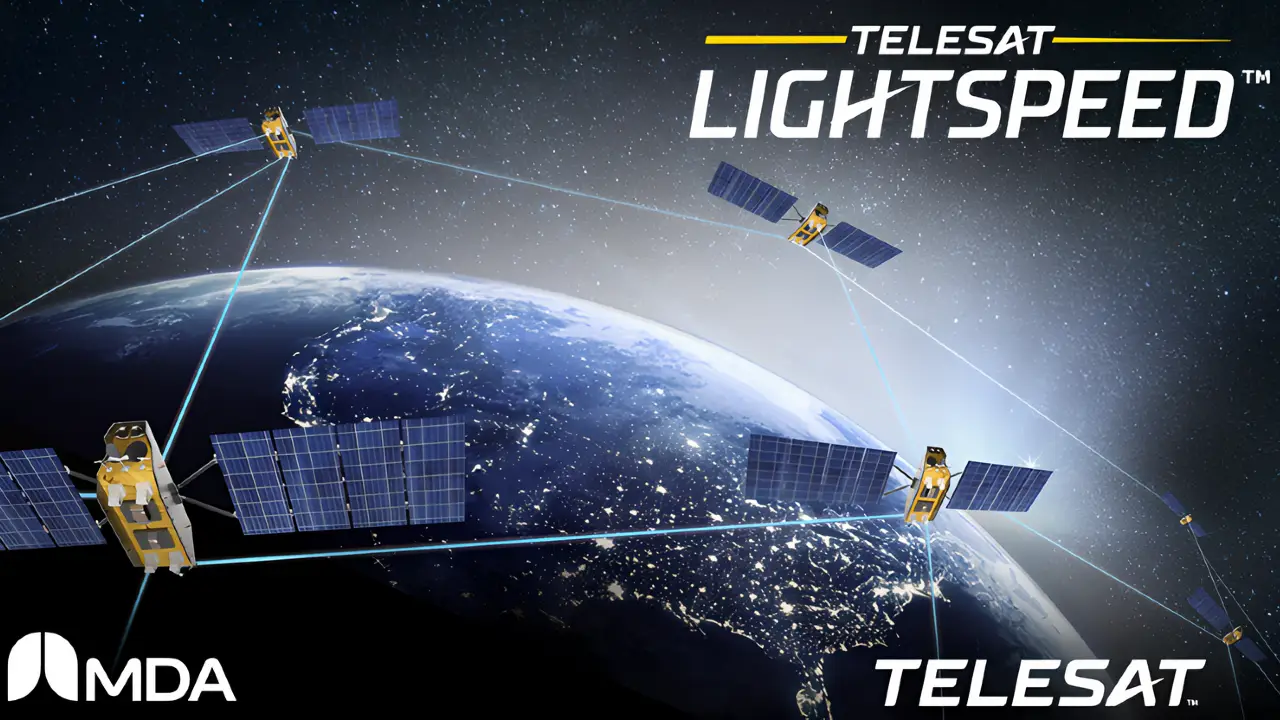 Telesat Lightspeed promo. Credit: Telesat
What made the moment remarkable was not the delay itself. In the LEO market of 2026, where constellations are pushing the absolute limits of onboard processing, beam-forming, and software-defined architecture, semiconductor bottlenecks are almost a rite of passage. What was remarkable was the clarity with which Goldberg described his response: his team was tracking chip development forensically, he said, and based on what MDA Space was telling him, he felt confident the components would arrive in time to support the revised schedule. That is not the language of a man in crisis. That is the language of a man who has already done something about the problem.
The Chip Bottleneck and Vertical Integration
The ASIC in question was the work of SatixFy, an Israeli company whose space-grade chipsets are at the heart of MDA Space’s Aurora satellite platform – the basis on which every Lightspeed satellite is built. For years this dependency was handled at arm’s length. Losing that supplier in the middle of a program – or watching that supplier get bought by a competitor – would have been a program-ending situation, not just an inconvenience in terms of scheduling. Then in July 2025, MDA Space outright acquired SatixFy for approximately $280 million, bringing the chip’s design, engineering talent, testing infrastructure and development pipeline fully inside a Canadian-controlled entity. It was not a reactive move. It was a strategic one – made precisely because MDA and Telesat knew that whoever controls the silicon controls the schedule.
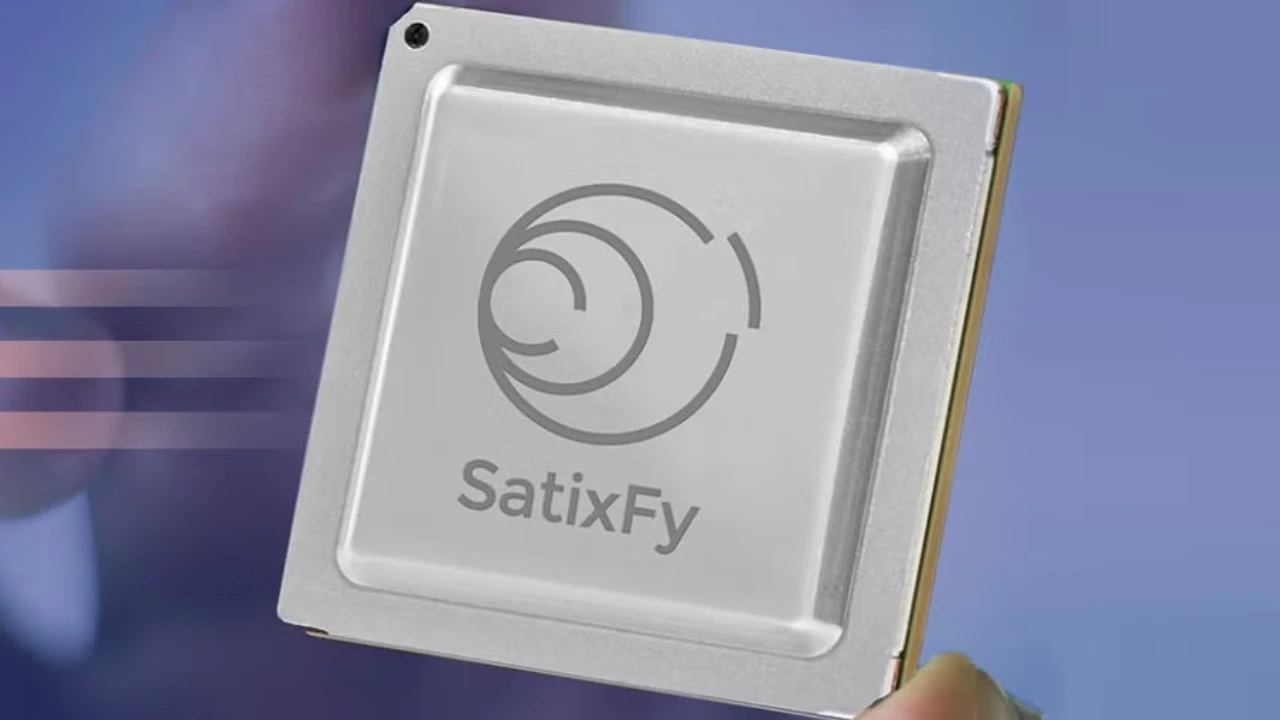 SatixFy chip. Credit: SatixFy
By March 2026, that decision was already paying dividends in terms of confidence, if not yet in hardware. Goldberg told investors that the first Lightspeed satellites were still on track to launch before the end of 2026, with a heavy launch cadence planned throughout 2027. The vertical integration of SatixFy into MDA’s Satellite Systems division meant that Telesat now had direct visibility into production timelines and qualification processes – the kind of visibility that is simply not available when a critical supplier sits outside your corporate structure. One tiny chip almost sank a billion-dollar program. Canada responded by ensuring that it would never be a stranger to that chip again.
From Commercial System to Strategic Infrastructure
The commercial story of Lightspeed is compelling enough all by itself. But in March 2026, it was revealed that Telesat and MDA Space were developing something bigger than a broadband constellation. Goldberg announced that 500 MHz of military Ka-band spectrum would be added to 156 satellites in the Lightspeed fleet. The cost, he said, would be modest – somewhere in the neighborhood of $25 million. The strategic impact, in his words, would be massive. Military Ka-band capacity has historically resided on geostationary satellites: the US Wideband Global Satcom system, the UK’s Skynet constellation, platforms developed for an era when latency was acceptable and the Arctic was a secondary theatre. That era is ending.
 Rendering of Telesat Lightspeed constellation. Credit: Telesat
This announcement did not come out of nowhere. In December 2025, Telesat and MDA Space had signed a strategic partnership agreement with the Canadian government under the Enhanced Satellite Communications Project – Polar known as ESCP-P. The program, led by Canada’s newly formed Defence Investment Agency, is designed to provide the Canadian Armed Forces with secure, multi-frequency satellite communications in Arctic environments – where there are no fiber cables, no cell towers and where the weather alone can end a mission. The funding envelope is more than five billion Canadian dollars. As of March 2026, the full contract remained under negotiation – a reminder that political commitment and signed funding are not necessarily the same thing, and that Telesat’s strategic position, however strong, still depends on a deal not yet closed. Goldberg was explicit about the ambition: Lightspeed’s polar coverage, low latency and distributed architecture would make this capability available not just to Canada, but to NATO and allied governments across the world. Canada was not developing a satellite system. It was making an argument for its own indispensability.
Competition, Execution, and the Sovereignty Question
The market that Lightspeed is entering was not waiting for it. OneWeb, operating under the Eutelsat umbrella with UK government backing, has already made a serious play in government, maritime and aviation connectivity – the exact customer segments Telesat is targeting. Amazon’s LEO constellation, which completed its first major production satellite launches in 2025, was moving fast with the full weight of Amazon Web Services cloud infrastructure behind it, and manufacturing scale that few can match. Both competitors bring with them financial firepower and operational momentum. Both will be further along by the time that Lightspeed is in service in early 2028.
But Goldberg’s argument – implicit in everything Telesat communicated in March 2026 – is that this race is not won based purely on deployment speed or raw capacity. Governments in 2026 are asking different questions than they were five years ago. They want to know who built the satellites, who designed the chips, who holds the encryption keys and who answers to which government when things go wrong. With SatixFy integrated into MDA Space, with the ESCP-P partnership signed and with military Ka-band spectrum woven into the constellation’s architecture, Telesat can offer something that OneWeb and Kuiper structurally can’t: a system built inside Canada’s industrial and security framework, accountable to Canadian law, and aligned with Canadian and allied defence priorities. Allied governments are watching closely – and for many of them, the question is not just whether Lightspeed works, but whether Canada can prove that sovereign industrial policy actually delivers. The delay to 2028 is real. The launch cadence through 2027 will be the test. But the sovereignty argument – that’s already in orbit.