
Strategic Collaboration for Next-Generation Defense
Dec 17, 2025
Kymeta Corporation and Innovative Rocket Technologies Inc. (iRocket) have announced a strategic collaboration focused on transforming missile defense through next-generation satellite connectivity. The partnership is all about developing, integrating, and testing Kymeta’s innovative conformal, multi-orbit antenna technology inside iRocket’s missile interceptor systems. This effort marks a notable change in how defense technology gets acquired, as the Pentagon increasingly turns to commercial providers for vital satellite services and defense tech.
 Kymeta and iRocket partner on next-generation missile defense connectivity. Credit: Google
The primary technical innovation is to integrate the conformal antenna technology by Kymeta directly into the bodies of the missiles of iRocket, creating a continuous multi-orbit, real-time satellite connectivity. This integrated system will transmit mid course updates to interceptors in flight which will in turn significantly increase precision and enhance functional robustness in the aggressive conditions in the event that the enemy attempts to jam or obstruct communications. According to Kymeta chief scientist Ryan Stevenson, missile interceptors need to operate in very degraded and jammed environments and they must have permanent access to targeting information and command-and-control connections as they travel at extreme velocities through hostile airspace. He emphasized that such weapons require connectivity regardless of attacks on GPS, tactical radio frequencies, and single-orbit satellites.
Conformal Antenna Technology
The conformal antenna created by Kymeta is a design thinking breakthrough, exploiting the special electromagnetic properties of metamaterials, which is the basis of the established engineering expertise of the company. This employs a surface-integrated design, as opposed to the conventional gimbaled or phased array antenna system, which is incorporated on the aerodynamic body of the interceptor. The conformal design not only radically reduces the drag and detectability, which are crucial to the interceptor performance, but also enhances results of the missions as well. Stevenson indicated that prior to the conformal multi-orbit solution of Kymeta, missile interceptors had to contend with complex antenna solutions which were difficult to task, communicate with and maintain thermally stable, and required multiple components or subsystems that consumed undue weight and power.
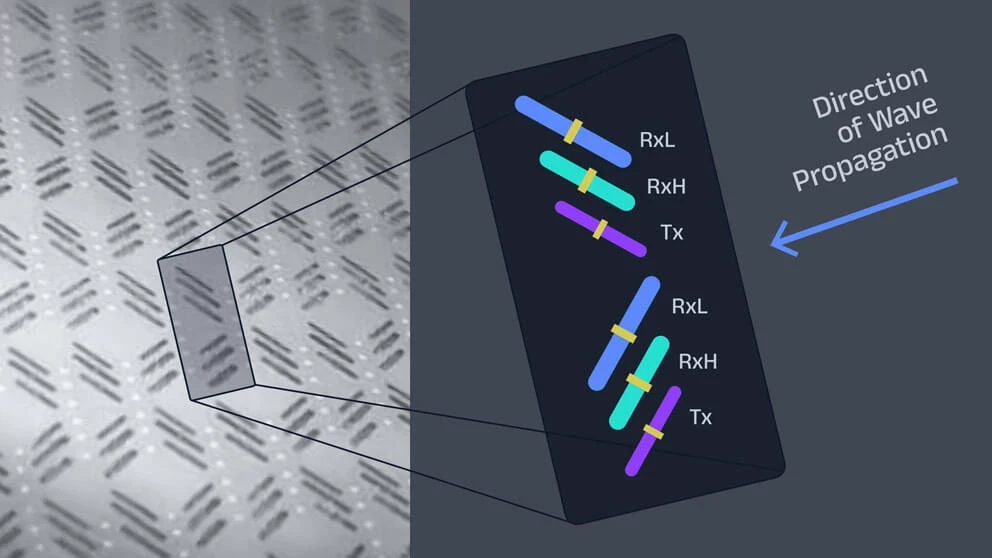 The TMA features one transmit and two receive bands, with each sub-array independently forming and steering its own beam. Credit: Kymeta
The partnership should deliver major mission improvements in several important areas. Better interceptor performance will come from precise, agile beam steering for both sensors and communications, dramatically boosting accuracy and operational success. Smaller size, weight, and power needs result from eliminating bulky mechanical parts, creating smaller, lighter, and more power-efficient systems that are vital for longer range, higher speed, and better maneuverability. Improved signal detection and security will happen through dynamic, low-power beamforming that strengthens tracking and communication while reducing thermal and electromagnetic signatures, boosting survivability in hostile territory.
Enhanced Performance and Mission Capabilities
Communications toughness will be guaranteed through multi-orbit and multi-band connectivity offering a full PACE communications setup, providing backup pathways for mission-critical data. The work focuses on iRocket’s IRX-100, a short-range missile that the company successfully flew for the first time last month. The ninety-one-centimeter-tall interceptor is being designed to work with the United States military’s Hydra 70 rocket system, aiming to generate early revenues to fund development of Shockwave, a thirty-eight-meter-tall vehicle meant for launching small and medium-sized payloads. iRocket’s founder, chairman, and CEO Asad Malik said that the IRX-100 will use this technology, as will larger missile systems, including new innovations and compatibility with older launchers and existing systems.
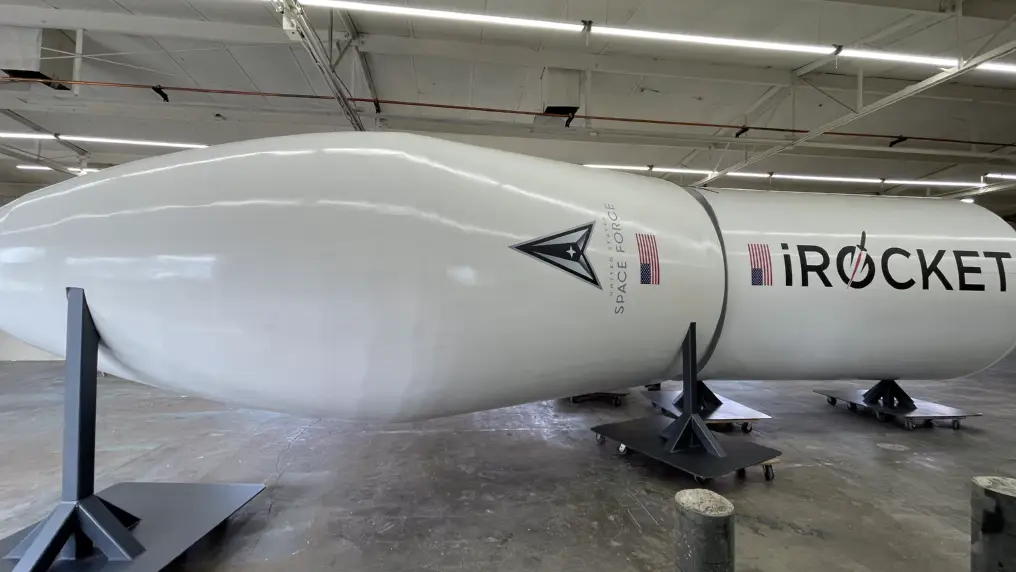 Full-scale Shockwave first-stage mock-up. Credit: iRocket
Malik called Kymeta’s metamaterial technology a game-changer for the company’s missile and space platforms, letting them build smarter, faster, and more efficient systems that can beat current technologies. Kymeta’s President and CEO Manny Mora stressed that as the United States government rushes to bring cutting-edge commercial technology into military systems faster and more flexibly than old-school rigid procurement methods allow, the work with iRocket meets this pressing need. He said the partnership shows how Kymeta’s metamaterial technology and iRocket’s advanced rockets can together provide critical new defense capabilities. Mora mentioned that Kymeta has already proven its metamaterials work for mobile, multi-orbit satellite communications and is now using that same innovation to tackle some of the toughest problems in missile defense and space domain awareness.
Industry Impact and Future Timeline
Stevenson stressed that multi-orbit connectivity would completely change interceptors from pre-programmed, mostly autonomous weapons into fully networked systems that can adjust during flight, stay connected in hostile conditions, and react to changing threats with much better precision and dependability. He said that a layered defense Golden Dome setup will need a fully networked, always-on defensive shield that can detect, track, and intercept moving threats over huge distances and in different domains. For this vision to work, interceptor missiles must stay linked to command-and-control networks throughout their entire flight path, not just at launch or terminal phase, with multi-orbit connectivity providing the needed toughness. The two companies plan to start joint development and testing right away, with first integration trials set for the second half of 2026.
This schedule fits with the larger Golden Dome program, for which Congress has appropriated nearly twenty-five billion dollars to launch President Donald Trump’s signature missile-defense initiative. Trump has said that Golden Dome could need up to one hundred seventy-five billion dollars over three years, though the Pentagon has shared few details about the program’s technical requirements and structure. Congressional Budget Office analysis puts the cost of a space-based interceptor layer alone at between one hundred sixty-one billion and five hundred forty-two billion dollars, depending on whether the system only defends the continental United States or gets expanded to wider tactical missions. The partnership news comes as iRocket gets ready for a public listing next year by merging with BPGC Acquisition Corp., a publicly listed shell company backed by former United States Commerce Secretary Wilbur Ross. According to investor presentation documents filed with the Securities and Exchange Commission, iRocket has gotten roughly fifty-two million dollars in funding and capital so far, including around forty million dollars from the Air Force Research Laboratory and Space Systems Command.
The Kymeta-iRocket partnership represents a significant step forward in modernizing American missile defense infrastructure through commercial innovation. By combining advanced metamaterial antenna technology with next-generation interceptor systems, both companies are positioning themselves at the forefront of the Golden Dome initiative. As the Pentagon continues to embrace commercial partnerships for critical defense capabilities, this collaboration demonstrates how private sector innovation can accelerate the development of sophisticated defense systems while reducing traditional procurement timelines and costs.