
Can Satellites Replace Cell Towers?
Jan 26, 2026
Airbus has unveiled its UpNext SpaceRAN demonstrator initiative, collaborating with major telecommunications and satellite industry players to validate standardized 5G non-terrestrial network capabilities. The initiative aims to establish an open and non-proprietary framework for satellite communications that offers a viable alternative to current proprietary systems dominating the marketplace. Participating organizations in this venture include Aalyria, AccelerComm, CesiumAstro, Eutelsat, the Industrial Technology Research Institute, Keysight Technologies, Onati, Radisys, Sener, and ST Engineering iDirect.
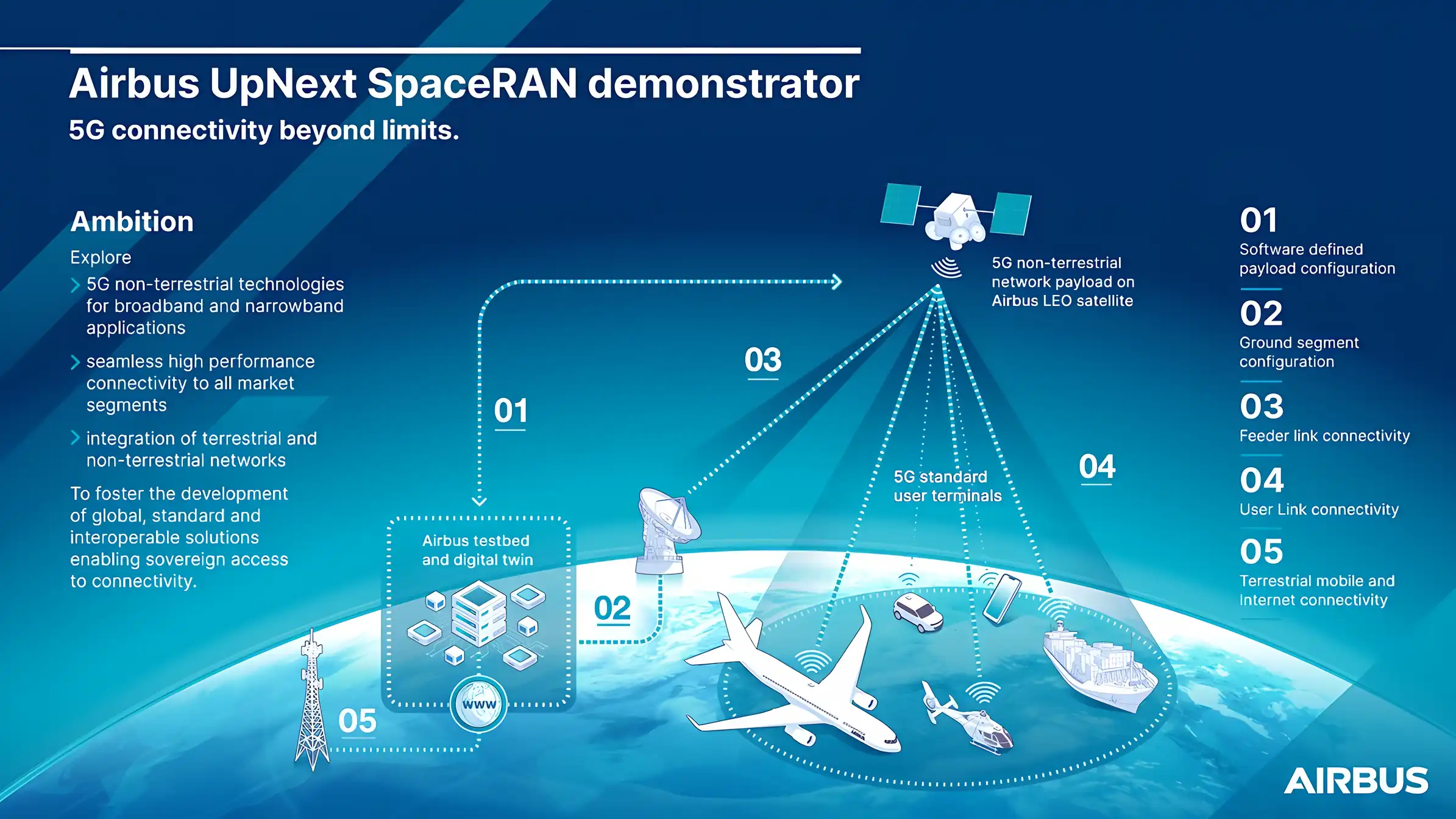 Airbus UpNext SpaceRAN architecture overview. Credit: Airbus
The demonstrator follows a two-step development plan that begins with terrestrial validation followed by space-based operations. Ground-based experiments will emulate a dual-satellite Low-Earth Orbit system in order to evaluate beam and satellite handover performance under both controlled and realistic conditions. After the successful terrestrial validation, the program will move to orbital deployment, which will deploy a 5G non-terrestrial network module to an Airbus LEO spacecraft, which is basically a cellular tower in space. It is planned to launch activities in 2027 and conduct orbital verification experiments during 2028 so that technical departments can evaluate the effectiveness of the operations and identify areas for improvement.
The project builds on progress made in November 2025, when the European Space Agency, Airbus Defence and Space, and Eutelsat successfully tested 5G New Radio signal transitions with a OneWeb satellite. After experimental activities in ESA installations, the Connectivity and Secure Communications directorate announced this achievement. The demonstration was of special importance as conventional terrestrial handover procedures for 5G were not compatible with the space-based network architecture, and new methodologies had to be developed. Researchers implemented a newly created Conditional Handover capability, which could quickly configure signals within a short satellite visibility period, which is a big step forward toward integrated earth-space network implementation.
The standardized 5G NTN services hold strategic value across civilian and defense sectors where diverse customer requirements determine the technological development path. In the view of Airbus, having standards is vital for customers who might need satellite infrastructure to act as communication fabric in integrated terrestrial-orbital network systems. Defense organizations are especially interested in autonomous, global and secure connectivity solutions free from proprietary platform limitations. Daniele Finocchiaro, who heads Telecom Research and Development at Eutelsat, stated that their organization became the first satellite service provider to prove NTN broadband with LEO spacecraft, and that the strategic value of being a technological leader was important.
SpaceRAN’s technical architecture incorporates cutting-edge software and hardware with help from various collaborative entities, illustrating the cooperative essence of emerging space communication systems. Aalyria confirmed that its intelligent management platforms will support the demonstration through dynamic control and performance enhancement of network operations. According to Chris Taylor, who leads Aalyria as CEO, achieving standardized orbital 5G connectivity is a key step toward expanding Non-Terrestrial Network deployment worldwide, while the SpaceRAN demonstrator offers valuable prospects for confirming that intelligent, software-centric management methods can improve NTN orbital effectiveness and hasten practical implementation. Elodie Viau, head of Telecom and Navigation Systems at Airbus, said that proving NTN transition capabilities marks major progress toward continuous global 5G broadband access, highlighting the technology’s transformative potential.