
Can Amazon Match Existing LEO Constellations?
Feb 16, 2026
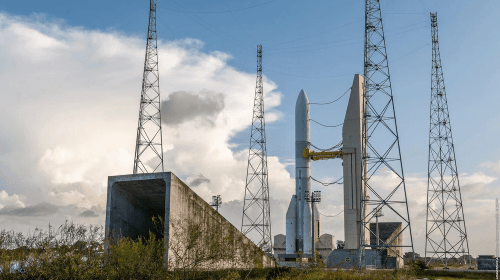
Arianespace sent 32 Amazon Leo satellites into orbit on February 12 from its launch facility in French Guiana. The rocket lifted off at 1:45 p.m. local time, and the mission took just under two hours to complete. This was Amazon’s first time using a European rocket to deploy its satellites, marking a new chapter in the company’s partnership with European space providers. The launch also introduced the Ariane 64 variant, which uses four solid boosters and is part of an 18-launch deal between the companies. The payload was heavier than anything Arianespace had previously launched. With this addition, Amazon’s constellation has reached 212 satellites in orbit.
 Amazon Leo’s Brand Logo. Credit: Amazon
According to ArianeGroup CEO Martin Sion, the mission shows what Europe’s space sector can now accomplish. He pointed out that two versions of the Ariane 6 are now available for different types of missions. Work is already in progress to make the rocket more competitive through payload upgrades and operational improvements. Meanwhile, Amazon is ramping up its launch pace significantly. The company plans around 20 launches this year and over 30 next year. Brian Olsavsky, Amazon’s CFO, told investors to expect about $1 billion more in spending on Leo this year because of all the launches. The rising costs reflect the scale and complexity of building out a global satellite network. Andy Jassy, the CEO, said commercial service will start this year, putting Amazon in direct competition with other satellite internet companies.
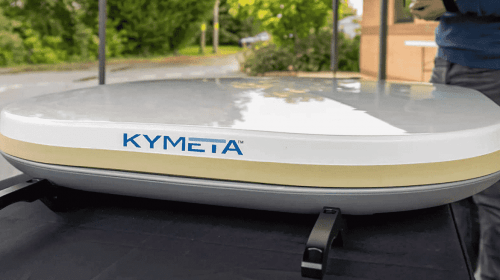
To support its commercial rollout, Amazon has developed specialized hardware for different market segments. Amazon’s Leo Ultra terminal is built for businesses and government agencies that need reliable high-speed connections in remote or challenging locations. The antenna can handle downloads at 1 gigabit per second and uploads at 400 megabits per second, which Amazon says makes it the fastest device of its kind currently available on the market. Inside are custom chips that Amazon’s engineers designed specifically for this purpose, along with algorithms that keep latency low and throughput high. Jassy explained that customers will get enterprise-level security with private connections straight to Amazon Web Services, skipping the public internet entirely. The hardware itself is substantial—20 by 30 inches and 43 pounds.
Amazon Leo will go up against competitors like Eutelsat’s OneWeb in serving consumers, businesses, and governments. The company has locked in deals with JetBlue for airplane wifi, plus contracts with Vanu Inc., Connected Farms, Hunt Energy Network, and Crane Worldwide Logistics. Right now, Amazon is sending Leo Pro and Leo Ultra units to certain enterprise customers for testing ahead of next year’s full commercial rollout. Amazon has put more than $10 billion into the project so far and plans to spend billions more. The company recently filed with the FCC asking for more time to hit its halfway deployment target, citing problems with launch vehicle availability, manufacturing delays, and spaceport bottlenecks. Despite these challenges, the project continues to move forward on schedule. Even so, Amazon says it will have the complete constellation up and running by the end of July 2029.