
Can Laser Links Finally Replace Radio for Satellite Data?
Nov 24, 2026
SES has demonstrated a laser communications link that carries data in both directions between the ground and a satellite in orbit. The test was part of the company’s meoSphere Pathfinder 1 mission, which is meant to prove out technology for a future network of the same name. That network is designed to get past the limits of traditional radio frequency links by using optical transceivers, which should allow more flexible and resilient data routing with fewer bandwidth bottlenecks. Demand for secure, high-capacity transport keeps growing among enterprise and government customers, and SES is aiming the system at them. To show the link working, the company sent high-speed video messages from Chief Executive Adel Al-Saleh across it. Pathfinder 1 is an early step, and the operational meoSphere constellation is still to come.
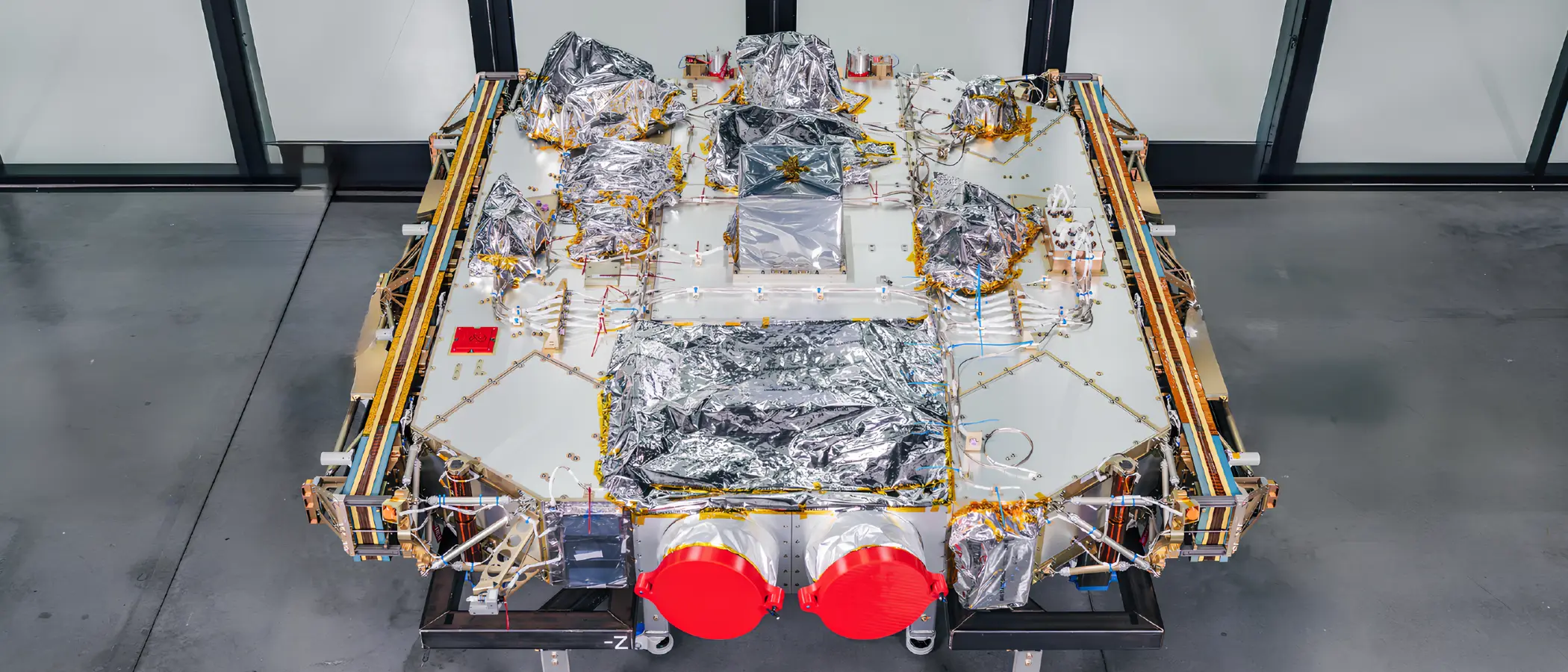 K2 Space Mega-class platform hosting the SES meoSphere Pathfinder 1 payload. Credit: K2 Space
The ground end of the link was an optical station operated by Cailabs in Rennes, France. On the space end, SES flew a communications payload aboard K2’s GRAVITAS mission, which is hosted on K2’s Mega-class satellite platform. The payload relied on a CONDOR optical communications terminal built by Mynaric. SES designed, developed and operated the optical mission architecture itself, and its in-house automation software handled the pointing and the exchange of data. Thales Alenia Space supported the work with system assembly, integration, testing and flight operations. In practice, the laser connection joined Cailabs’ ground station directly with the SES payload in orbit. Several companies contributed hardware or expertise, while SES kept control of the mission design and software.
Carmel Ortiz, senior vice president of medium Earth orbit programs at SES, said the result validates the company’s vertically integrated, iterative way of building next-generation space capabilities. Ortiz said SES and its partners have moved data between space and the ground successfully and more than once, which shows how optical communications perform in an operational setting. The work is not finished, though. The Pathfinder 1 team plans more flight testing to make the optical link last longer, measure data transmission rates and check how steady the pointing stays. Telemetry from those tests will feed into future Pathfinder precursor missions and speed up deployment of the operational meoSphere constellation.
The optical work sits alongside other moves SES is making. Since acquiring Intelsat, the company has become the largest commercial satellite operator by fleet size, combining Intelsat’s geostationary capacity with its own medium Earth orbit O3b mPOWER constellation. That combination brings Intelsat’s global enterprise customer base together with SES’s multi-orbit fleet. Its medium Earth orbit satellites use electronically steered spot beams, while the geostationary ones cover wide areas. SES has also been sharpening its focus on Central Asia and the South Caucasus after the European Union committed to mobilize up to €623 million for digital and transport infrastructure along the Middle Corridor trade route. Jean-Philippe Gillet, president of SES Fixed Vertical, welcomed that European policy support for regional network development, and recent aviation connectivity agreements in Central Asia point to real demand for multi-orbit capacity there. Nothing in those reports ties the corridor push directly to the optical tests, but both show a company working to build out its multi-orbit network.