

Is 5G NTN Reaching a Turning Point?
Mar 23, 2026
ST Engineering iDirect, a global leader in satellite communications, announced a live demonstration of native 5G NR-NTN (New Radio Non-Terrestrial Network) connectivity at the Satellite 2026 Conference, a milestone in the company’s ongoing 5G roadmap. The demonstration included a satellite-optimized 5G gNodeB fully integrated into the company’s cloud-native Intuition ground system, which allows end-to-end standards-based 5G NR satellite access in a variety of real-world scenarios. From the 5G User Equipment all the way to the 5G core network, the showcase demonstrated how satellite connectivity is rapidly converging with the terrestrial mobile infrastructure — a shift that could redefine global coverage expectations.
 ST Engineering iDirect promo. Credit: ST Engineering iDirect
Interoperability was a major theme throughout. The technology is compatible with both 3GPP and non-3GPP NTN systems, which is particularly important for operators who are trying to run advanced 5G applications in hybrid environments where ground-based coverage just doesn’t reach. CTO Sridhar Kuppanna described the demonstration as a cornerstone of the company’s hybrid 5G approach — the kind of groundwork that allows operators to move from non-3GPP setups to full 3GPP NTN access without having to rip up what they’ve already built.
The demonstration marks the second significant pillar in the 5G NTN roadmap of ST Engineering iDirect, following the company’s earlier work on non-3GPP roaming. The gNodeB stack inside the Intuition system is a result of years of satellite RAN development and is very much in line with current 3GPP NTN specifications. Kuppanna also pointed to the company’s recently demonstrated GNSS-free 5G NR capabilities as a clear sign of where things are heading — not just for today’s 5G rollouts, but for whatever hybrid 5G-6G architecture comes next.
Meanwhile, a defense-focused arm of the company, iDirect Government, has been making significant parallel strides on the military communications front. iDirectGov successfully ran a live over-the-air point-to-point test of the DVB-S2X standard on its 450 Software-Defined Modem, achieving a full-duplex link of 200 Mbps over a military Ka-band spot beam — a result that underscores the platform’s readiness for actual operational conditions. The test focused on the company’s proprietary Virtualized Waveform Core architecture, which enables multiple waveforms to be efficiently operated on a single modem platform — a big leap towards a smaller, lighter, less power-hungry solution for warfighters operating at the tactical edge.
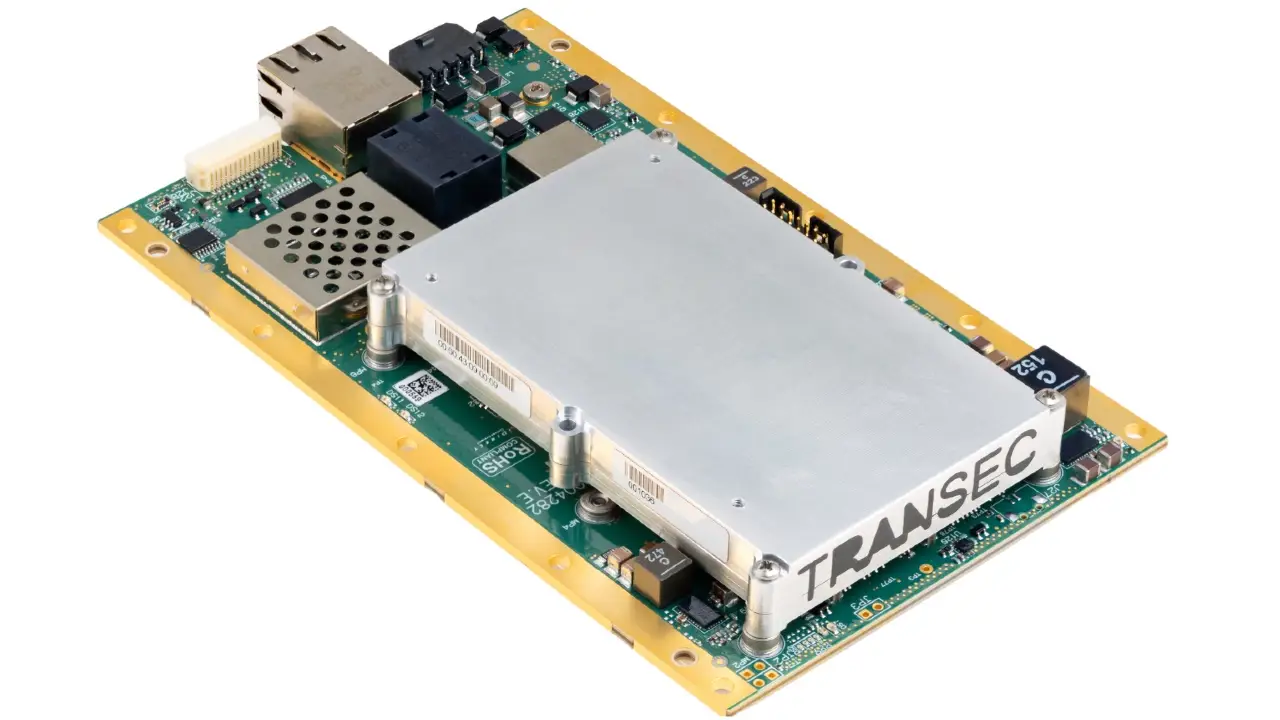 iDirectGov’s 450SDM. Credit: iDirect Government
iDirectGov’s 450SDM proved the kind of operational flexibility and battlefield resilience that modern defense communications increasingly require, including wide support for GEO, MEO, LEO, and HEO orbits, along with full compliance with stringent security standards including FIPS 140-3 Level 3 and Wideband Global SATCOM certification. The modem’s Waveform Development Kit opens the door to third-party developers contributing encrypted waveform cores through secure, predefined interfaces to help accelerate the deployment of both commercial and government-specific communication solutions — without sacrificing security or interoperability. Taken together, the advances from both ST Engineering iDirect and iDirectGov paint a clear and compelling picture of where the company is determined to steer the satellite communications industry: toward unified, software-defined, standards-based networks capable of serving everyone from remote enterprises to frontline military units — seamlessly, securely, and at scale.