
Full Constellation Triples Global Capacity Across Key Markets
Sep 24, 2026
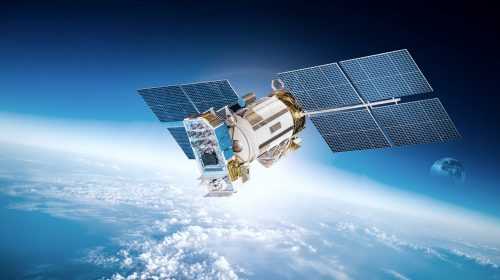
Viasat now has its full ViaSat-3 constellation in operation after bringing F2 online over the Americas last week. The satellite was actually the second of the three to launch, lifting off in November 2025, but only recently completed the work needed to enter service. F3 had already begun serving the Asia-Pacific region in late August, leaving all three spacecraft operational for the first time across Viasat’s wider global network.
 Credit: ViaSat
Each ViaSat-3 satellite was engineered from the ground up to add over 1 terabit per second of raw throughput, providing Viasat with a massive block of extra transmission bandwidth across its global coverage footprint. F1, launched back in 2023, has been running with a caveat the whole time. An antenna deployment anomaly limited it to only a fraction of its intended payload capacity, even though the spacecraft has remained operational. With all three satellites now online, Viasat confirmed the completed constellation has tripled the bandwidth available across its entire active global fleet, a combined gain from F1, F2, and F3 working together rather than any single satellite alone. F2 specifically anchors that expanded capacity over the Americas, directly supporting commercial flight corridors, maritime shipping lanes, government users, and fixed broadband markets where data demand continues to expand rapidly across the region.
Beamforming technology is what Viasat considers the real differentiator here, letting the satellites dynamically direct capacity toward wherever demand happens to be concentrated, whether that’s heavily trafficked air routes, congested ports, or a specific region experiencing a spike in usage. CEO Mark Dankberg described the VS3 satellites as the most advanced commercial spacecraft in the world when it comes to adaptive beamforming, pointing to cost efficiencies, faster speeds on both forward and return links, and stronger resistance to interference. He also credited the constellation’s solar power generation and thermal dissipation technology as setting new commercial standards, framing both as critical hurdles that will need solving if economical data centers in space ever become a reality.
Viasat isn’t the only operator wrapping up a major constellation this month. Just days before F2 came online, SpaceX launched the final three satellites for SES’s O3b mPOWER network, bringing that Luxembourg-based operator’s medium Earth orbit constellation to 13 spacecraft total. The Falcon 9 carrying those satellites lifted off from Cape Canaveral on September 13, deploying its payload at an altitude of 8,000 kilometers roughly 33 minutes after liftoff. Ten O3b mPOWER satellites were already working in orbit before the launch, and the latest three are expected to enter service by mid-2027. Each of the new satellites weighs about 1,700 kilograms and was built by Boeing, while SES sells the network’s capacity to telecom operators, airlines, shipping companies, government agencies, and the military. The newer spacecraft join 20 first generation O3b satellites also operating in MEO, giving SES a larger combined fleet for its connectivity business across a range of markets around the world. Following the liftoff, SES CEO Adel Al-Saleh highlighted the completed mPOWER architecture as a decisive shift for the company’s orbital infrastructure, one that reinforces its ability to deliver resilient, secure, and scalable connectivity worldwide. The timing puts SES in a similar position to Viasat, with both operators now sitting on newly finished, high-capacity constellations aimed at overlapping commercial and government markets.