
Maxwell Begins Five-Month Test of Commercial Relay Services
Oct 25, 2026
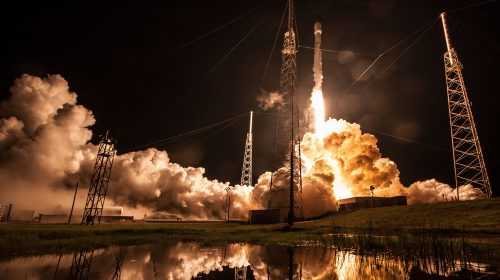
Viasat has launched its Maxwell spacecraft as part of a NASA effort to find out whether commercial companies can take over a job that government satellites have done for decades. The spacecraft launched into low Earth orbit aboard a Falcon 9 from Cape Canaveral Space Force Station at 7:04 a.m. ET on October 20, during the Bandwagon-5 rideshare mission that carried 32 payloads from customers in several countries. It is the second demonstration Viasat has run under the NASA Communications Services Project, after a test last November in which the company relayed launch telemetry during a Blue Origin New Glenn flight. John Reeves, a vice president at Viasat Government, said the launch pays off years of engineering work shared by Viasat, NASA, and their industry partners. The mission matters because NASA is preparing to retire its aging Tracking and Data Relay Satellite fleet, the first of which began operating in 1983.
 Credit: Viasat
Rocket Lab built Maxwell at its factory in Long Beach, and the spacecraft supplies the power, attitude control, and propulsion for the equipment on board. Viasat equipped it with a space-qualified Ka-band terminal designed to reach its ViaSat-3 satellites, plus an L-band terminal connected to its L-band network, while Rocket Lab supplied a radio for telemetry and command tests. The satellite can also send data down to Viasat’s Real-Time Earth ground network in the S-, X-, and Ka-bands. Together, those links are meant to give spacecraft in low orbit a steady path for data and commands, instead of waiting for a ground station to come into view. Skylar Cox, the chief technology officer of Viasat Space and Mission Systems, said the team had been preparing for this launch for a long time, and that the overall goal is to show continuous relay service in low Earth orbit.
Viasat’s work is being carried out under two NASA Communications Services Project awards totaling about $81 million. In 2022, NASA’s Space Communications and Navigation division awarded $278.5 million across the wider program to develop commercial satellite services for space missions. SES Space and Defense launched its own relay demonstration on a Planet Pelican satellite on the same Bandwagon-5 flight, so two separate commercial relay demonstrations reached orbit together. The program is managed by NASA’s Glenn Research Center in Cleveland, which plans to keep testing relay capabilities with industry through 2027.
Viasat is beginning on-orbit testing as part of a five-month campaign scheduled to run through March 2027. During that time, the team will test Ka-band and L-band relay services designed to carry low-latency data for spacecraft in low Earth orbit. If the tests go well, Viasat will be able to show NASA and other customers that commercial networks can handle traffic from both government and commercial satellites. NASA is also pursuing commercial communications services for networks around the Moon and eventually Mars, rather than owning every link. A NASA program official has said a unified internet for the solar system is a long-term goal, though Maxwell itself focuses on near-Earth relay services.