
Supply Chain Concerns Emerge Over Rocket Lab Deal
Nov 23, 2026
The FCC’s Space Bureau first gave Globalstar U.S. market access for its third-generation C-3 system, and the commission then wrapped up its review of Amazon’s purchase of the company just days afterward. The price tag is $11.5 billion, although some industry estimates land closer to $10.8 billion. What Amazon gets is mostly spectrum, plus about two dozen satellites already in orbit. Amazon announced the deal in April, so the full review took about six months from start to finish. France issued its own C-3 authorizations a couple of weeks later, bringing three major regulatory decisions in roughly three weeks. That is an unusually quick pace, and the timing suggests officials on both sides of the Atlantic saw little reason to slow things down.
 Credit: Amazon
FCC Chairman Brendan Carr said the approval would help Amazon Leo roll out faster satellite broadband and add competition in communities across the country. He also described the decision as part of a push to restore American technology leadership. The agency itself found no material harm to the public interest. It pointed instead to better coverage in unserved and underserved areas, stronger emergency communications and more intensive use of satellite spectrum as the likely benefits. Under the approved terms, Globalstar becomes a wholly owned Amazon subsidiary and keeps its corporate name, operating as an affiliate of Amazon Leo. The FCC also said Amazon is preparing to launch commercial satellite services by the end of this year. Amazon still expects the deal to close in 2027, once the remaining closing conditions are satisfied. Speed at the approval stage, in other words, is not the same as a finished transaction.
France Hands Globalstar a Twenty-Year Spectrum License
The French ruling applies to the C-3 network, which Globalstar filed with the International Telecommunication Union as AST-NG-C-3. It gives the company 20 years of authorization to use mobile satellite spectrum for the network and permits flight operations across the satellites’ full 13-year design life. The decision was made by both the country’s digital and space ministries. In this instance, France is more than a paperwork stop, as Globalstar maintains a satellite operations control center in Toulouse, in addition to its primary facility in Covington, Louisiana. That gives Paris a real connection to how the network is run. The 20-year term also exceeds the design life of the satellites, giving the operator time to plan for replacements.
The constellation requires 54 satellites, 48 of them operational and six spares, all manufactured by MDA Space. The 48 working satellites will orbit at 1,414 kilometers above the Earth, in 12 orbital planes of four satellites each, inclined 52 degrees to the equator. Each carries an S-band payload with active beamforming, allowing it to communicate directly with standard handheld phones. U.S. regulators approved 1610 to 1618.725 MHz for links up from the ground and 2483.5 to 2500 MHz for links back down. The first launches are scheduled for next year, and the satellites are designed for emergency messaging as well as normal mobile service.
Eight Satellites Pass Tests With Millions at Stake
A separate mission, Globalstar 2-R, matters just as much to the purchase price. Eight of its 17 replenishment satellites rode a Falcon 9 out of Cape Canaveral in August, and MDA has since reported that all eight passed their first functional tests in orbit. Payload health checks are still underway. Electric orbit raising has started for the first two spacecraft, while the other six will begin climbing as their orbital planes line up. Rocket Lab is supporting the orbit raising for all eight, after which the satellites climb to a final testing altitude and then move to their operating orbit. This is the unglamorous stretch of the job, but it is also where problems tend to surface, so the early results carry real weight for everyone involved.
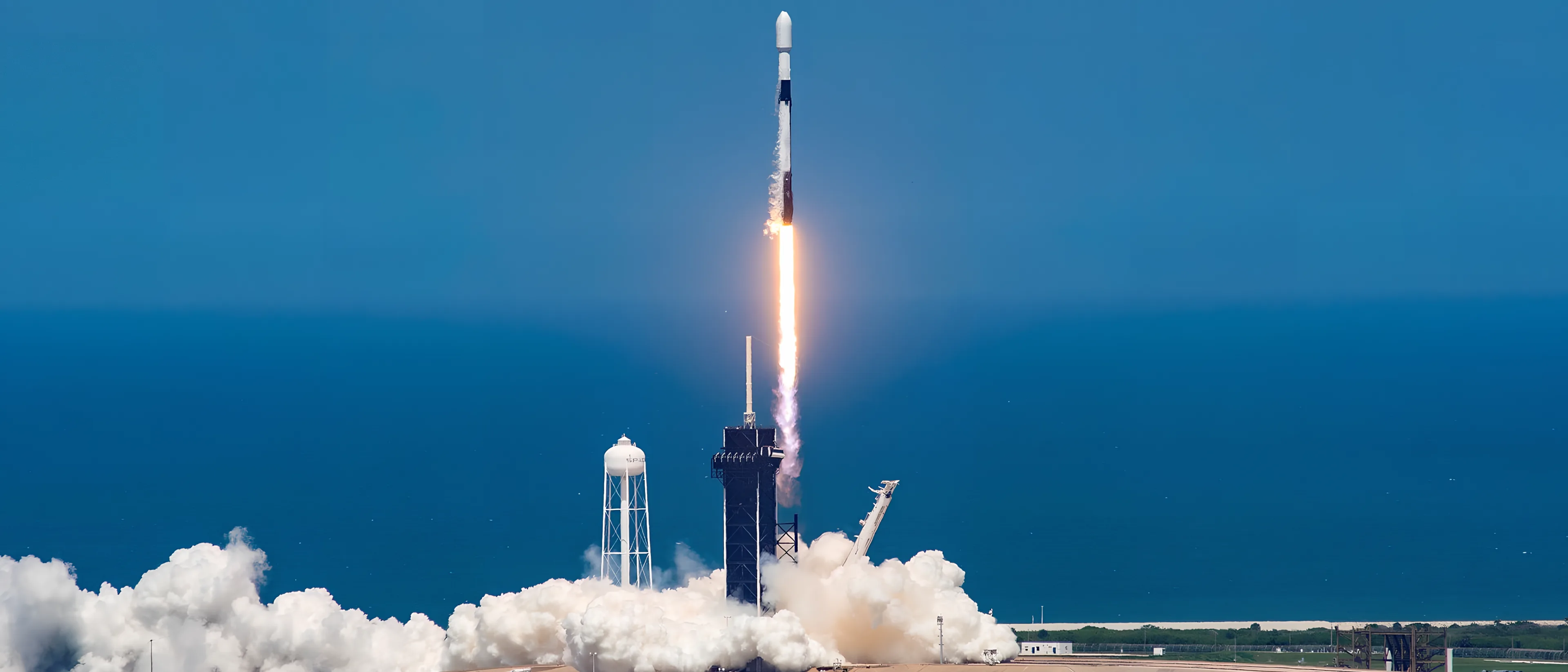 Falcon 9 Block 5 rocket launches the Globalstar 2-R mission. Credit: Globalstar
Part of the price Amazon pays depends on operational milestones for the replacement satellites, and if Globalstar misses them, the total can fall by as much as $110 million. The remaining nine satellites have finished final integration at MDA’s facility in Montreal, although neither company has named a launch date. MDA’s chief executive, Mike Greenley, said the team has logged several firsts, from assembly and testing through launch and the work since, and that the focus now is on execution and delivery to the customer. These are also the first satellites MDA has delivered as prime contractor for a commercial communications constellation, which makes the stakes personal for the company as well as for Amazon.
Rocket Lab’s Iridium Deal Complicates Globalstar’s Supply Chain
Rocket Lab built the satellite buses as a subcontractor to MDA. It also supplies Globalstar’s flight and ground software and developed the control center that operates the satellites. Now Rocket Lab is acquiring Iridium, Globalstar’s direct rival in the Big LEO spectrum band. Globalstar told the FCC it does not oppose the purchase, but it wants regulators to look hard at the supplier relationship. Its argument is that Rocket Lab would gain ongoing influence over the timing and performance of a rival’s constellation, plus a view into that rival’s spacecraft design, operations and delivery schedules. Today the two companies’ interests line up, Globalstar says, but after the deal Rocket Lab would have both the motive and the means to favor Iridium.
Globalstar also asked the agency to examine Iridium’s past regulatory conduct, accusing it of repeated attempts to capture Globalstar’s licensed spectrum through filings. The FCC affirmed both companies’ exclusive rights in the band earlier this year and rejected Iridium’s request to revise it. Rocket Lab responded that the deal will not harm competition or the public interest, since it holds no mobile satellite spectrum and has no near-term path into Big LEO services. If both acquisitions close, Amazon and Globalstar will face Rocket Lab and Iridium in the direct-to-device market. Until then, the FCC still has the Rocket Lab review open, and Globalstar’s supplier concerns sit right in the middle of it. Both sides will keep filing, and the FCC’s answer could shape how suppliers and operators share sensitive information across the industry.