
Can Amazon Meet Its FCC Deadline?
May 19, 2026
Amazon’s satellite internet goals are gaining pace, but the company has a long way to go between where it is and where it needs to be in order to reach the regulatory milestones it is required to hit. In the span of one week, in late April 2026, two successful launches brought the number of satellites in Amazon’s Leo constellation to 300, though that’s still only about a tenth of the company’s ultimate target of 3,232 satellites. Amazon is ramping up its push as the deadline looms and it’s possible that the future of its broadband plans remains uncertain.
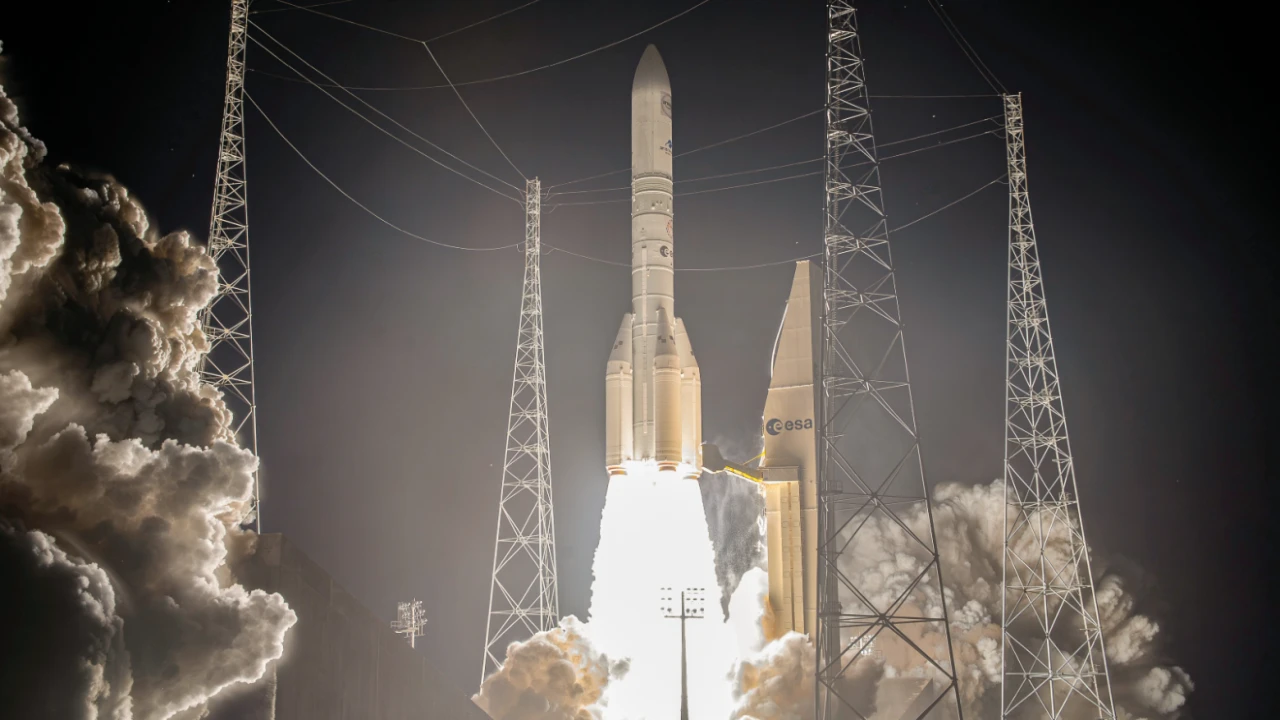 Amazon Leo’s LE-02 lifts off from Europe’s Spaceport in Kourou. Credit: Arianespace
The week’s first launch took place on April 27, when the Atlas 5 551 launched from Cape Canaveral, Florida, with 29 Amazon Leo satellites on board the mission, known as Amazon LA-06. Three days later, on April 30, an Ariane 64 rocket, the most powerful four-booster configuration of the Ariane 6 launcher, lifted off from Europe’s Spaceport in Kourou, French Guiana. The rocket delivered 32 satellites into a 465-kilometer parking orbit in under two hours, on the flight Arianespace designated VA268 and Amazon called LE-02, the second of 18 contracted Ariane 6 missions. The two launches brought Amazon’s total in-orbit satellites to 302, a symbolic but still modest move towards its full constellation.
The launches were welcomed by executives on both sides of the partnership. The second Amazon Leo mission marked another step in Ariane 6’s commercialization process, reaffirming Ariane 6’s ability to support the emerging constellation market with reliable and competitive launch solutions, Arianespace CEO David Cavaillolès said. ArianeGroup CEO Christophe Bruneau also said that the industrialization rate of Ariane 6 production was definitely picking up speed, as this seventh successful flight and second in the four-booster configuration confirmed the reliability of Europe’s heavy-lift launcher. Each successful deployment brings the constellation one step closer to commercial service, but the journey remains long.
The more pressing issue for Amazon is a regulatory deadline set by the U.S. Federal Communications Commission. Amazon is required to place 1,616 satellites, or half its constellation, into orbit by July 30, 2026, under the terms of its FCC license. At this time, it is not close to that level. Amazon made its request in January, suggesting that a delay of two years or a waiver would be necessary because of a shortage of launch capacity in the near term. The company took great care to state it was not trying to delay its ultimate July 2029 deadline to complete the entire constellation. To help catch up, Amazon announced in March that it would increase its flight frequency to over 20 launches a year, and in its FCC filing revealed it had booked 10 more Falcon 9 launches with SpaceX to augment its manifest.
Amazon’s launch pipeline is still in trouble, however, even with those efforts. ULA’s Vulcan rocket, contracted for 38 Amazon Leo missions, has been grounded since February after debris shed from one of its solid rocket boosters, with no return-to-flight date announced. Meanwhile, on April 19, Blue Origin’s New Glenn suffered an upper stage failure when one of its two BE-3U engines failed to generate enough thrust during a second burn, stranding an AST SpaceMobile satellite in an unrecoverable orbit, according to Blue Origin CEO Dave Limp. New Glenn is also a key part of Amazon’s plans, having signed up 24 launches to date. Amazon’s next launch is scheduled for May 22, using an Atlas 5, and then an Ariane 6 with upgraded P160C solid rocket motors, which will enable the vehicle to lift more satellites per launch, though neither Amazon nor Arianespace has revealed the exact amount. Whether these efforts will be sufficient to appease regulators, or whether Amazon will require a formal FCC reprieve, is the key issue that hangs over the entire Leo program.