
Building the Blueprint for a Circular Orbital Economy
Apr 19, 2026
Japanese orbital services company Astroscale has announced an ambitious new mission that, if successful, will mark a turning point for the commercial space industry. The company revealed that its upcoming ISSA-J1 mission, developed under Japan’s Small Business Innovation Research program, will attempt something never before accomplished by a private firm: the inspection of two separate retired satellites located in two distinct orbits, using a single servicer spacecraft. Engineers are currently assembling the spacecraft, with a launch window set for 2027.
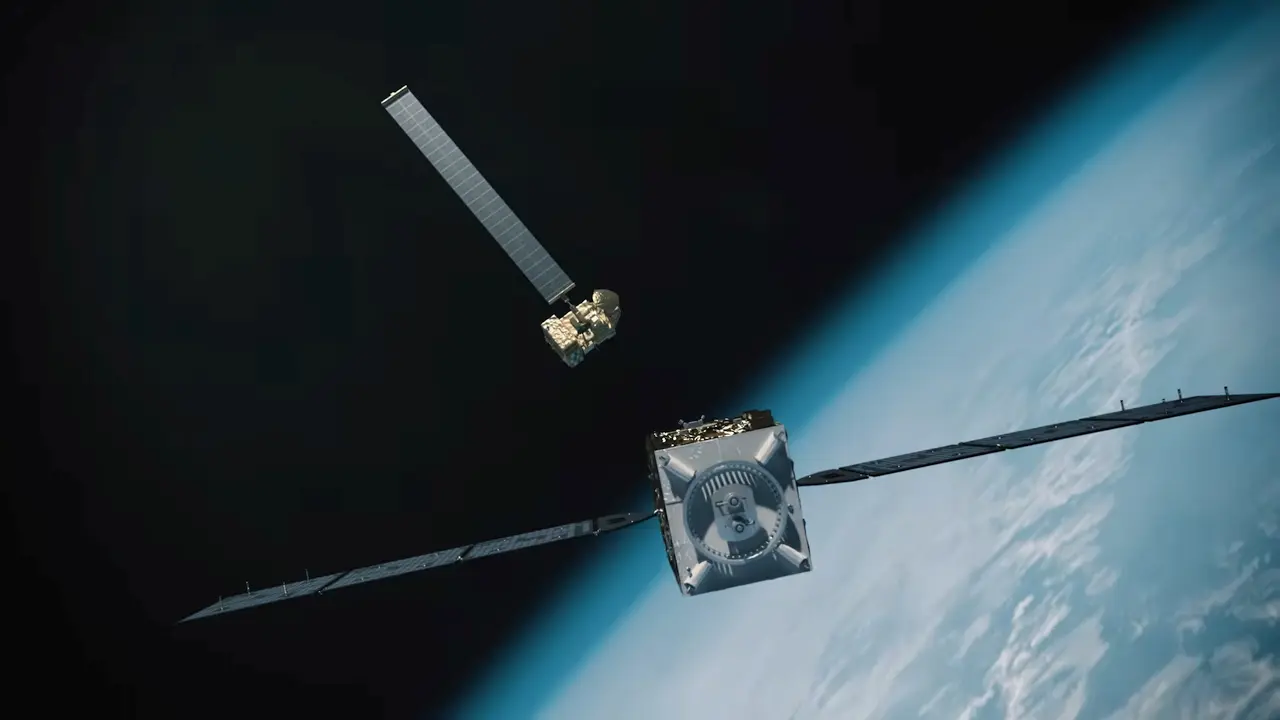 ISSA-J1 promo. Credit: Astroscale
The two objects that will be targeted in the mission are legacy spacecraft from the early 2000s Japanese Earth-observation program. The Advanced Land Observing Satellite (ALOS) was decommissioned in 2011, and the Advanced Earth Observing Satellite-II (ADEOS-II) was put out of service in 2003, soon after launch, due to a critical power failure. By flying close to these long-inactive bodies, the inspection craft of Astroscale will capture high-resolution images and sensor data to assess the structural integrity and rotational behavior of these bodies – data that cannot be acquired by ground-based tracking systems by their very nature.
Company officials described the capability to examine the state of a spacecraft at a small distance as a gap that is very important in space situational awareness. Ground-based operators of crowded orbital environments have long been capable of tracking objects from the ground, but these techniques tell little of the true physical condition of a satellite after decades of radiation exposure, thermal cycling, and bombardment by micrometeorites. The leadership of Astroscale suggested that the results of the ISSA-J1 would provide the international community with a priceless point of reference concerning how materials and structures age in the severe conditions of the low and medium Earth orbit.
The technical issue that lies at the core of ISSA-J1 is the fact that it is possible to navigate between two distinct orbital regimes within one mission. Astroscale described this as one of the main challenges in commercializing in-orbit servicing and making it scalable. The company has already shown close-proximity rendezvous with its ADRAS-J mission in 2024, the first commercial mission to rendezvous with and characterize a piece of space debris. ISSA-J1 is intended to extend that base, adding several targets in various orbital regimes to it – a feature the company said would be critical as satellite servicing demand increases.
The ISSA-J1 announcement comes alongside news of another landmark endeavor: Astroscale is also preparing to conduct the first-ever on-orbit refueling of United States Space Force satellites in geostationary orbit, with that hydrazine refueling mission expected to take place in the summer of 2026. Taken together, the two programs signal a broader shift in how the space industry thinks about the lifecycle of satellites and the long-term sustainability of Earth’s orbital environment. Rather than treating spacecraft as disposable assets, companies like Astroscale are advancing a vision of a circular orbital economy — one in which satellites can be inspected, repaired, refueled, and safely decommissioned as a matter of routine, keeping vital orbital pathways open for future generations.