
9604 Module Enables Resilient Satellite and Cellular IoT
Feb 25, 2026
Iridium Communications has taken a decisive step toward redefining the industrial IoT connectivity landscape with the introduction of the Iridium 9604, a three-in-one module that brings satellite, cellular, and positioning technologies together within a single compact platform. Announced on February 24, 2026, the release signals a strategic transition for the company, which has traditionally focused on satellite-only hardware but is now expanding toward a unified multi-mode connectivity approach. Measuring just 16 mm by 26 mm by 2.4 mm, the 9604 is Iridium’s smallest module to date and is built on the u-blox SARA-R5 platform. It integrates Iridium Short Burst Data satellite messaging, LTE-M cellular connectivity, and GNSS positioning — capabilities that previously required multiple discrete components and significantly larger board space.
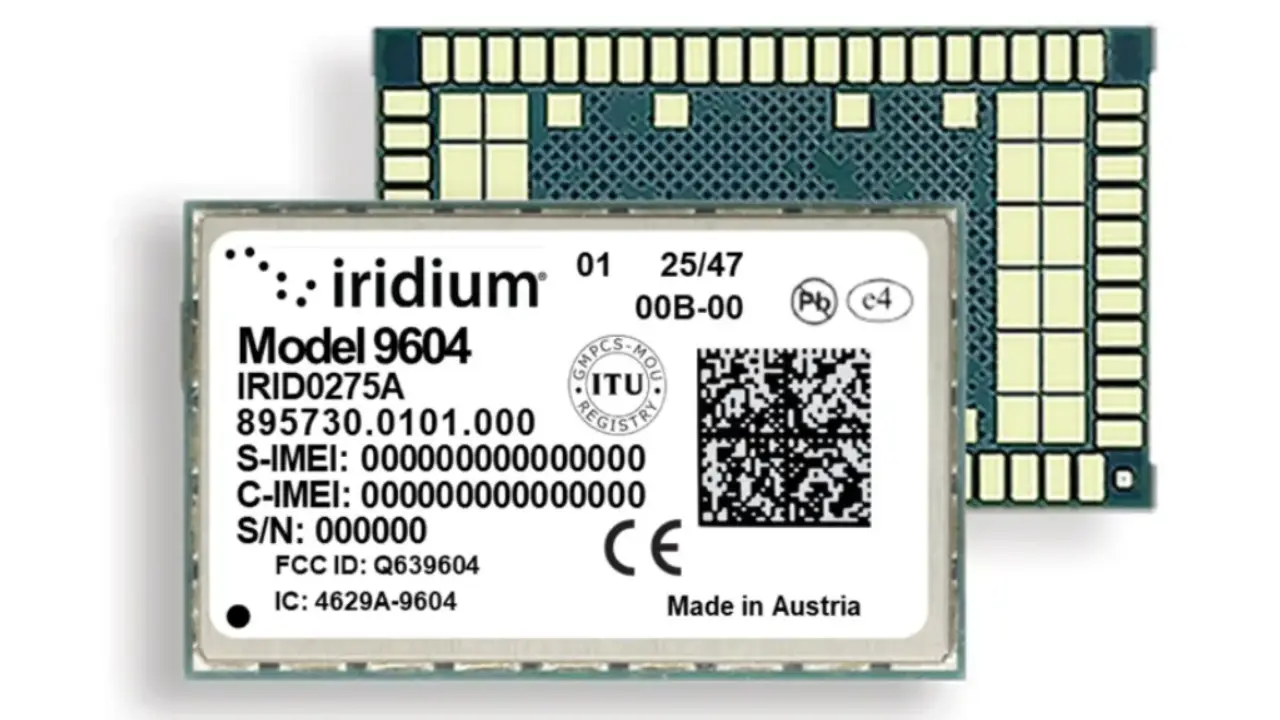 Iridium 9604 module. Credit: Iridium
From the engineering side, the consolidation solves long-standing design constraints that IoT hardware developers have been experiencing. Tim Last, Executive Vice President at Iridium, explained that the integration was meant to allow customers to deploy smaller, lower-cost, and more power-efficient solutions without the complexity of combining separate connectivity subsystems. According to the company, the module cuts the amount of board space required by over 60 percent compared with conventional multi-component architectures, which is particularly meaningful to manufacturers that have strict size, weight, and power requirements. Last also indicated that in addition to Iridium’s proprietary satellite IoT services and a standards-based NB-IoT capability that is expected later in 2026, the company wants to position itself as a primary connectivity option for deployments that extend beyond terrestrial network coverage.
Feedback from the oversubscribed beta program, which included a select group of hardware partners, indicated practical benefits during real-world product development. Alastair MacLeod, CEO of Ground Control, said that adoption of the 9604 had dramatically changed the product economics of his company by eliminating two components from the bill of materials while simplifying overall power architecture. He added that dual-mode connectivity allowed for more intelligent, location-aware network selection, effectively turning what would have been a complex multi-component integration effort into a single-module implementation. Dean Welten, CEO of Everlink, noted that combining the 9604 with Everlink’s secure cloud platform had made it possible to deliver global connectivity with measurable operational improvements at scale for enterprise customers.
The Iridium 9604 is the first in a series of three parallel IoT service paths the company is pursuing in 2026. In addition to the new module, Iridium is developing Iridium NTN Direct, a standards-based direct-to-device solution intended for smartphone-class connectivity, and the Iridium Certus 9704, an industrial-grade module intended to support larger payload requirements using the Iridium Messaging Transport protocol. Commercial availability of the 9604 is planned for June 2026, and a dedicated Development Kit is planned for simultaneous release to enable engineers to test the real-world switching between satellite and cellular services. For system integrators and OEM hardware designers evaluating future global IoT architectures, the module’s lower integration complexity, dual network resilience and highly compact form factor make it a platform of note as the Direct-to-Device ecosystem continues to mature across multiple global industry segments.