
TÜV Approval Clears Path for European Rail Trials
Sep 22, 2026
Kymeta’s Kestrel u5 terminal has received full certification from TÜV Rheinland ahead of connectivity trials with some of Europe’s largest rail operators. The approval covers key railway requirements, including EN 50155, EN 45545-2 and EN 50121, which address equipment standards, fire safety and electromagnetic compatibility. Kymeta is now preparing to take the terminal into trials with rail operators, system integrators and train manufacturers across Europe. The company is also targeting a broader rollout in both European and global markets once those tests progress.
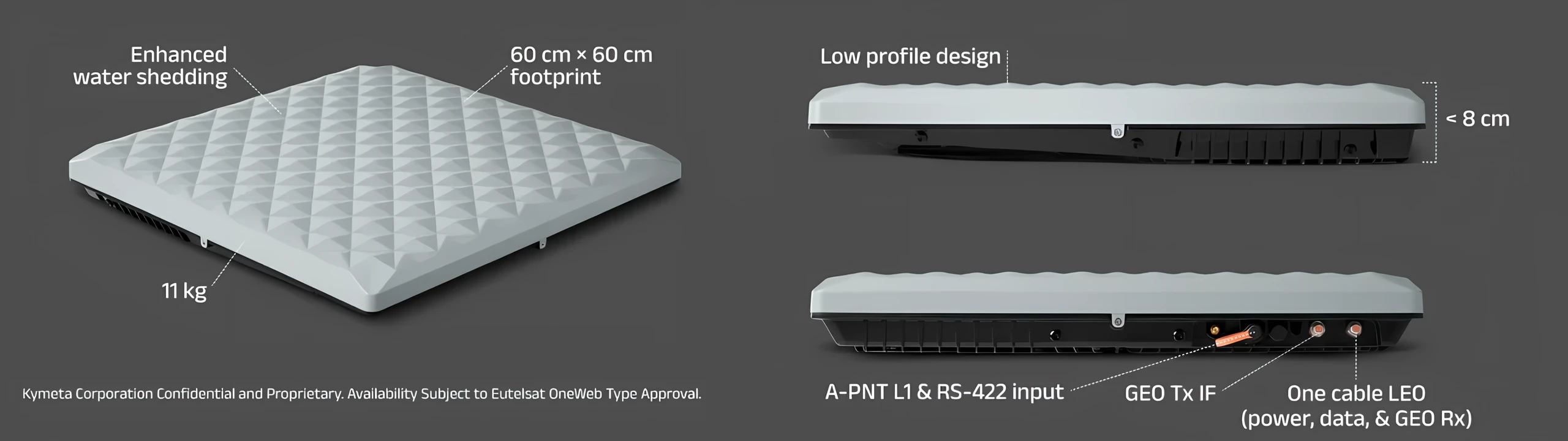 Kymeta Kestrel u5 Terminal. Credit: Kymeta
The Kestrel u5 was built specifically for demanding rail applications rather than being adapted from a different commercial product. It uses a flat-panel, no-moving-parts design that can be mounted on the roof of a rail carriage, with an IP69K rating and average power consumption below 100W. Its passive cooling system is paired with a patented radome designed to shed water while the train is either stationary or moving, while the overall construction is intended to handle vibration, weather exposure and constant motion. The terminal also provides full-duplex connectivity, allowing it to handle uplink and downlink simultaneously, with low latency and broadband performance.
One of the terminal’s main selling points is its ability to move between LEO and GEO connectivity, although the multi-orbit function is available as an optional capability for rail customers. Kymeta also supports a failover between satellite connectivity and existing cellular networks, giving operators another layer when coverage changes along a route. CEO Manny Mora described the TÜV certification as a major milestone and linked it to the company’s investment in manufacturing the terminal. He said the approval addresses a long-standing problem with inconsistent rail connectivity and allows the Kestrel u5 to provide the secure, always-on service Kymeta has been targeting.
The next step is a series of additional connectivity trials planned over the following 60 days. Kymeta says the testing will include high-speed runs of up to 360 km/h, with the aim of demonstrating reliable performance under demanding operating conditions. Some onboard trials have already been successful, giving the company an early indication of how the terminal performs before the next round of operator testing. From there, Kymeta expects the Kestrel u5 to move toward a wider rollout across European rail markets and eventually into markets around the world.
The rail push is happening alongside a separate expansion in Kymeta’s defense business. Earlier in September, the company received a $20 million order from a branch of the U.S. Department of Defense for 100 Osprey u8 multi-orbit satcom terminals, with the award also covering connectivity services on Kymeta’s global Broadband network. That network combines LEO and GEO connectivity, while the Osprey u8 terminals can switch between TRANSEC and non-TRANSEC networks depending on operational requirements. Kymeta said the latest order takes deliveries of terminals and connectivity services to more than $30 million for that specific DoD branch during 2026, while Mora said the award reflects continued confidence in the company’s ability to support mission-critical operations. The company did not identify the specific DoD branch because of security concerns.