
A Single Antenna for a Multi-Band World
Apr 23, 2026
For decades, military operators and enterprise users alike have faced a frustrating tradeoff in satellite communications: accessing different frequency bands meant carrying different hardware. Ku-band terminals served one purpose, Ka-band systems served another, and combining them into a single platform meant added bulk, complexity, and cost. Kymeta, the Redmond-based flat-panel antenna manufacturer, is now moving decisively to close that gap with its upcoming KuKa 8 Series terminal, a software-defined solution engineered to handle both bands simultaneously through a single aperture. The ambition behind the project reflects a broader industry shift — one in which the proliferation of satellite constellations across multiple orbits has made the old single-band, single-orbit approach increasingly inadequate for users who need guaranteed, uninterrupted connectivity wherever they operate.
 Kymeta promo. Credit: Kymeta
None of this came out of nowhere — it traces back to a lab demo where Kymeta’s engineers got four beams running off a single metamaterial surface at once, two pushing data out and two pulling it in simultaneously. That was the moment the whole project stopped being theoretical and started feeling like something that could actually ship. Getting four independent beams to cooperate through a single aperture had been one of those problems the industry quietly assumed would take much longer to crack, which makes the speed of what followed all the more striking. The company hasn’t really slowed down since that demonstration, and the pace of development suggests this isn’t a team that’s content to sit on a good result. The timeline tells the story pretty cleanly: the breakthrough got validated in June 2025, first prototypes are heading to select customers this summer, and the full commercial launch is penciled in for 2027.
The Technology Behind the Breakthrough
At the heart of the KuKa 8 Series is an interleaved sub-array architecture built into a flat metamaterial surface. Unlike earlier Kymeta generations that relied on liquid crystal tuning, this design moves to a different switching mechanism specifically chosen for faster response times and greater resilience in extreme environmental conditions. The result is a terminal capable of supporting simultaneous Ku-band operation across 10.7 to 14.5 GHz and Ka-band operation across 17.7 to 31.0 GHz — all within a single, electronically steered flat panel that measures 35.4 inches by 35.4 inches and stands just 3.9 inches tall. For engineers accustomed to the size and complexity of legacy multi-antenna installations, those dimensions alone represent a significant engineering achievement.
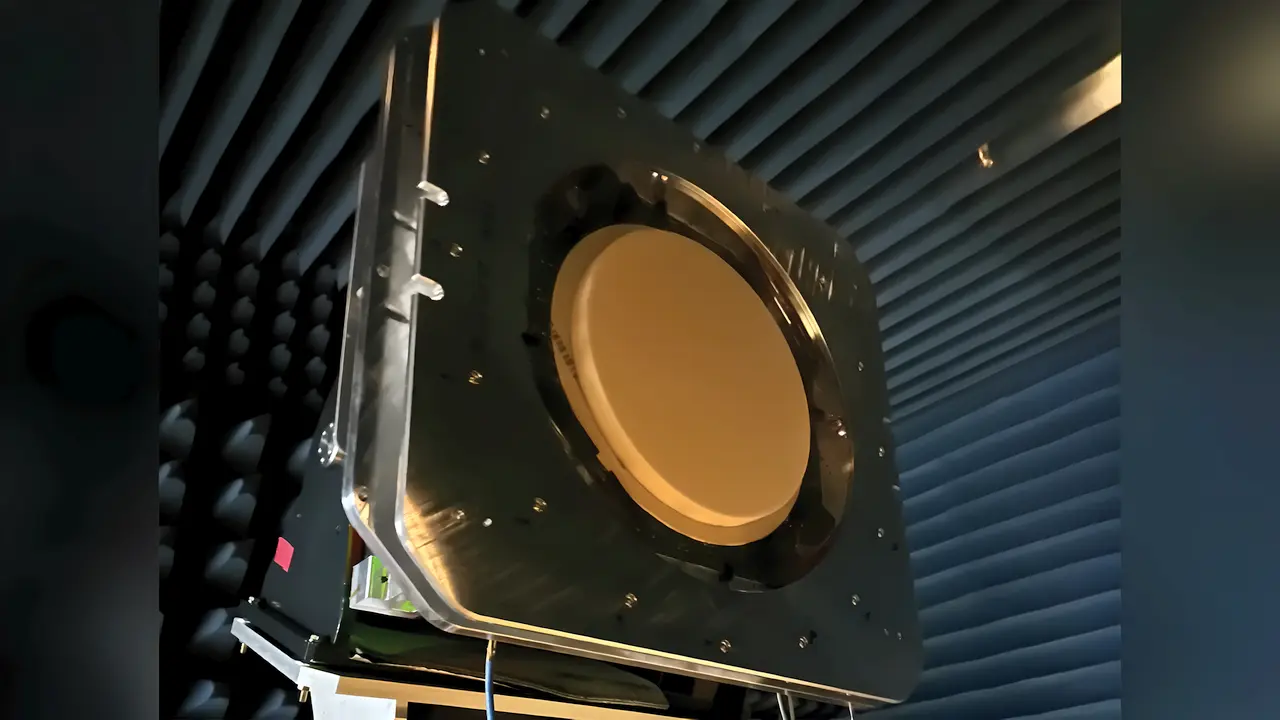 Kymeta’s KuKa 8 Series multi-orbit SATCOM antenna prototype. Credit: Kymeta
In addition to frequency coverage, the terminal is designed to operate seamlessly across multiple orbital regimes, such as Geostationary orbit, Medium Earth Orbit, Low Earth Orbit, and Highly Elliptical Orbit. Dual-modem integration enables the system to support concurrent data streams across multiple bands simultaneously, which Kymeta claims is indeed simultaneous multi-constellation access. Chief Scientist at Kymeta Ryan Stevenson detailed how where customers once needed to add multiple terminals to even access different networks (not to mention use them simultaneously), the KuKa 8 Series provides all that functionality in a single platform, and the size, weight, power, and cost metrics are also much improved overall, by about 44 percent over conventional side-by-side multi-antenna designs.
Aligning with Defense Priorities
Kymeta has made it clear that the KuKa 8 Series will first target the national security community. The architecture of the terminal aligns with the U.S. Space Force’s emerging “network of networks” vision, which requires communications systems capable of smoothly shifting across several satellite constellations and frequency bands without human operator intervention. In a competitive environment where jamming and electronic warfare can cut a connection at any time, diversity in pathways in multiple orbits and bands in parallel is not an option, but a necessity of the mission. That type of built-in resilience is more valuable than ever before due to the increasing threat landscape, where adversaries are increasingly able to attack predictable single-network communications.
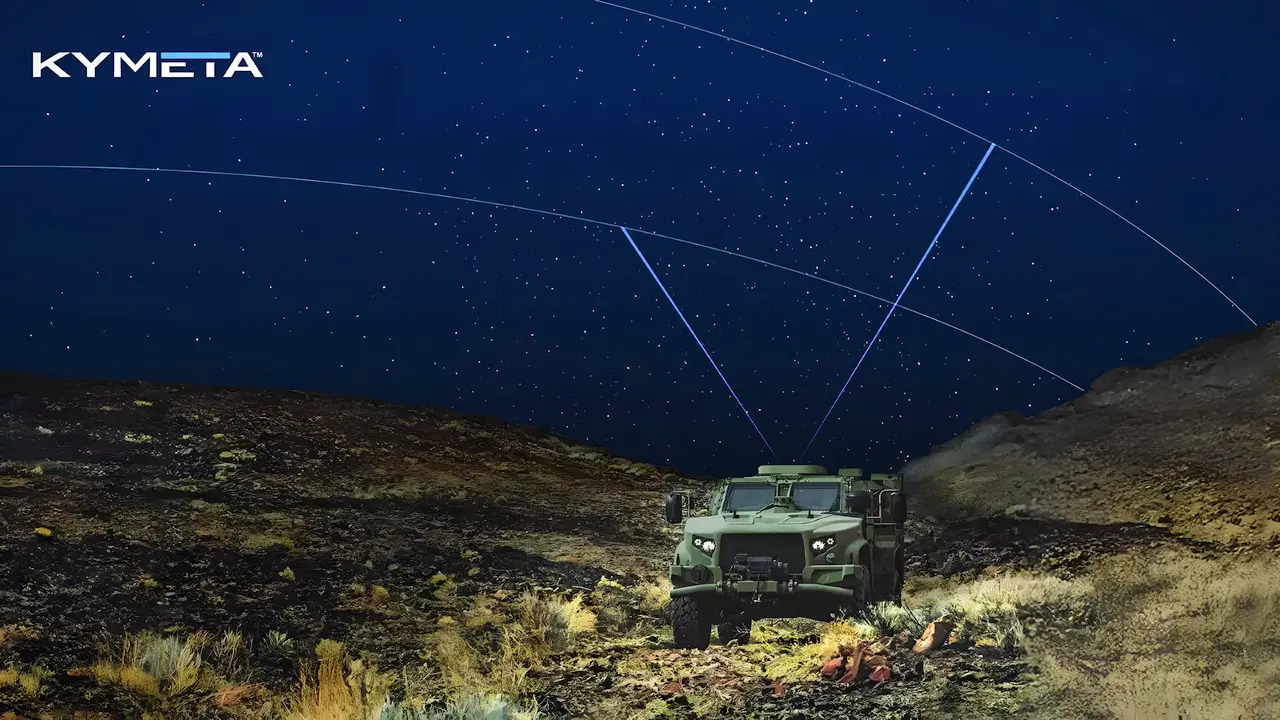 Kymeta promo. Credit: Kymeta
In November 2025, Kymeta hired Manny Mora as President and Chief Executive Officer to spearhead commercialization of this technology into the defense sector. Mora had 40 years of experience at General Dynamics Mission Systems and the company made clear that his mandate was to align Kymeta’s flat-panel technology to the needs of the Department of Defense Joint All-Domain Command and Control or JADC2. Mora has publicly mentioned that the capability to bridge Ku- and Ka-band connections with a single mobile antenna is a fundamental advancement toward making satellite communications as effortless and automatic as cellular networks, a criterion that defense planners have long desired but seldom attained with older hardware.
From Prototype to Market: The Road to 2027
The prototype release in the middle of 2026 will be aimed at a particular and challenging audience. Early adopters of the hardware will be defense units working at the tactical edge, the maritime operators taking care of communications on vessels in motion, and aviation platforms where space and weight are at a premium. Kymeta has stressed that Size, Weight, and Power plus Cost – the SWaP-C factors that dictate procurement in both military and enterprise markets – are a key focus of all things about the KuKa 8 Series design philosophy, including the switching architecture and the size of the panel itself. Each gram saved and each watt saved is directly translated into operational benefits to the platforms that will bring this terminal into the field.
After the prototype stage and the milestones of Technical Readiness Level 6 have been reached, Kymeta engineering teams are working on the further miniaturization of the hardware to be used in the wider tactical deployment. The commercial deployment in 2027 will feature product variants that target enterprise-grade mobile backhaul and emergency response operations, and will extend the reach of the terminal far beyond its original defense applications. With the Office of Naval Research locking in a three-year development contract in April 2026, and Bascom Hunter already ordering the first prototype for U.S. Navy testing, the momentum behind the KuKa 8 Series is hard to ignore — and it’s a reasonable bet that the broader SATCOM industry will look pretty different by the time that 2027 launch actually lands, and Kymeta will undoubtedly be leading that change.