

New Threats to Cables and Pipelines Raise National Security Concerns
Jan 21, 2026
Russia is expanding its war against Ukraine into a new and largely unseen domain beneath the sea, bringing serious risks to Britain’s national security. While news reports focus on the land battles, security specialists warn that the real danger may be growing in the ocean depths, away from public view. Britain’s digital economy and energy supply depend on underwater systems that could be deliberately targeted, as subsea cable networks carry roughly 99 percent of international data transmissions globally while pipeline infrastructure delivers petroleum products and natural gas required for home heating and manufacturing. According to Eugen Ciemnyjewski, chief executive of subsea security firm EUROATLAS, intelligence indicated Moscow was building a fleet of self-operating submersible craft designed to cripple or destroy these vital systems—stealth platforms that can operate at depths of several thousand meters below the surface.
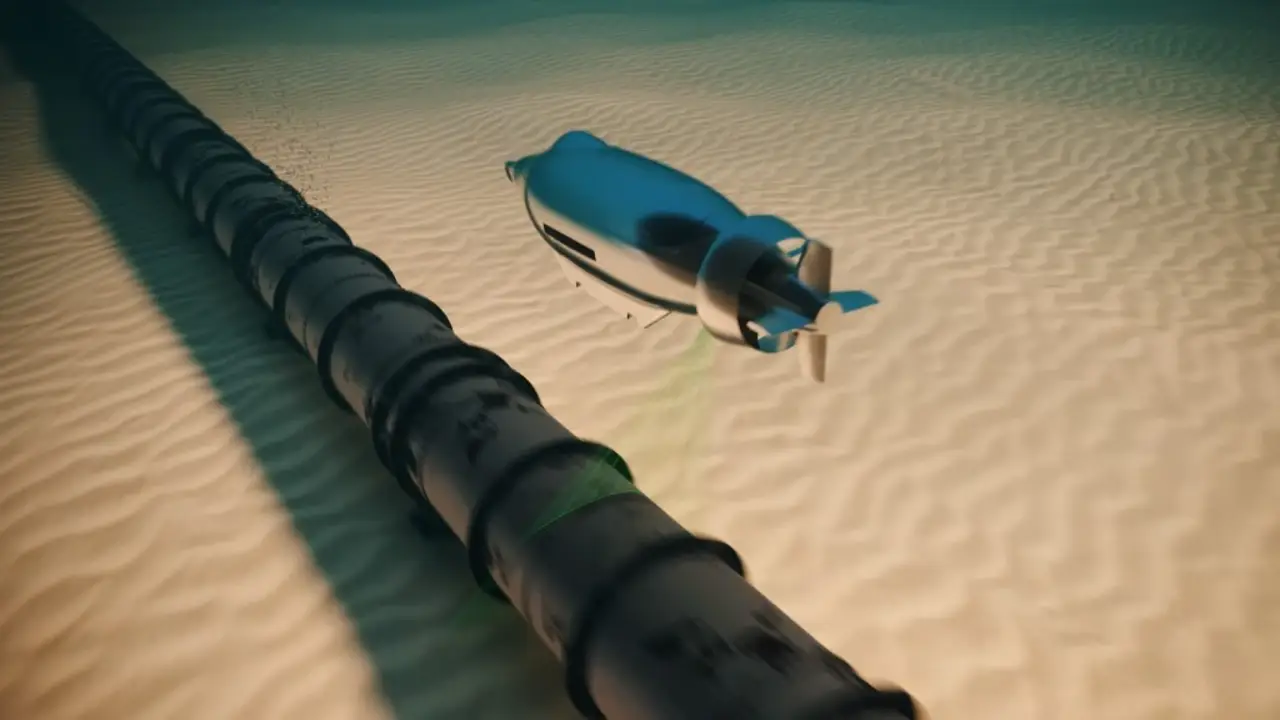 3D render of The Greyshark Series 2 Foxtrot AUV by Euroatlas, built for autonomous subsea infrastructure surveillance. Credit: Euroatlas
The UK is uniquely vulnerable because its transatlantic data flows concentrate through very few cable landing points. Despite having 64 separate undersea cables reaching its shores, approximately three-quarters of UK-US internet traffic runs through just two cables that make landfall at Bude in Cornwall. Military and security analysts warn that coordinated attacks on subsea cables or energy pipelines could freeze banking systems, trigger nationwide communication and power outages, and spark widespread panic—all without firing a single conventional weapon. This growing and complex threat demands urgent joint efforts by government and industry to safeguard the hidden foundations that modern British society relies upon.
Russian Naval Activity and Ambiguous Warfare Tactics
Rising worries about Russian naval movements near vital British infrastructure have pushed security agencies to increase defensive monitoring. Surveillance operations have tracked Russian naval vessels acting suspiciously near undersea cable routes, leading Defense Secretary John Healey to publicly name the spy vessel Yantar conducting mapping operations in UK territorial waters. British military intelligence reports show the Kremlin is actively modernizing its submarine fleet with the clear aim of threatening undersea communications and energy infrastructure, representing a deliberate expansion of hybrid warfare methods. Intelligence analysts note that Moscow intentionally takes advantage of the unclear nature of undersea incidents, where infrastructure damage can easily be blamed on maritime accidents like dragging anchors, mechanical problems, or operational mistakes rather than deliberate sabotage.
 Russian spy ship Yantar in UK territorial waters. Credit: Google
A bipartisan legislative panel has delivered sharp criticism of governmental preparedness, describing current defensive measures as inadequate in light of the magnitude of possible threats. The Joint Committee on the National Security Strategy identified Britain’s subsea cable network as a key vulnerability in the event of conflict, saying that protective measures have been too timid in defending these essential assets. While recognizing that the commercial operators of cables have shown reasonable capability to recover from limited damage and concluding that there are currently low immediate threats to national connectivity, the committee warned against letting commercial risk assessments determine national security planning. The panel specifically called attention to the fact that the hostile escalation by Russia could occur much faster than corresponding improvements to British defensive capabilities, emphasizing that the possibility of deliberate targeting of UK infrastructure during global tensions can no longer be dismissed as improbable.
The Atlantic Bastion Initiative Reshapes British Naval Power
To counter these emerging fears, British officials have introduced the Atlantic Bastion initiative, a major project that has been launched to enhance defense against underwater attacks along the North Atlantic. Defense Secretary John Healey characterized this effort as bringing a fresh approach to Royal Navy operations, integrating cutting-edge autonomous systems and artificial intelligence with conventional naval platforms and aviation assets to generate an advanced hybrid defensive capability. This initiative positions Britain at the leading edge of naval technological innovation, merging self-operating surface craft and submersible platforms with sophisticated digital systems while maintaining traditional warship and patrol aircraft capabilities. As the First Sea Lord, General Sir Gwyn Jenkins referred to the program as marking a major shift in maritime military operations that will unite human crews with robotic devices and artificial intelligence.
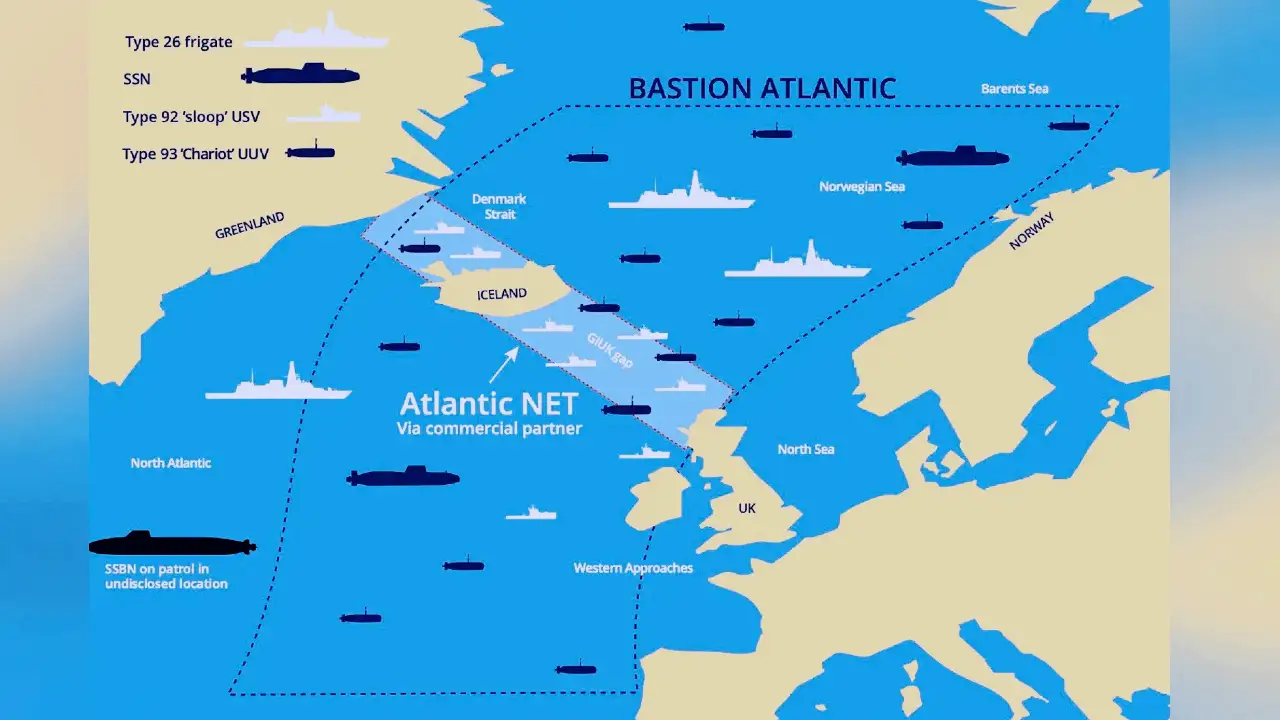 Atlantic Bastion operational zones and GIUK gap maritime defense. Credit: Google
The initiative has attracted a great deal of commercial interest and joint government-industry funding of a total of £14 million has been committed for current year development and testing activities. A total of 26 companies from the UK and Europe have submitted technical proposals for anti-submarine detection systems, while 20 corporations are actively demonstrating prototype technologies, with private investment matching public funding at a 4:1 ratio. The Atlantic Bastion framework will connect maritime vessels, submarine platforms, aircraft and unmanned systems via AI-enhanced sonar detection capabilities to form an interconnected digital targeting infrastructure. This innovative weapons coordination network is intended to drastically speed up decision-making and response times when engaging hostile undersea threats.
Building Layered Defense Approaches
Parliamentary oversight groups have pushed for stronger deterrent policies that include serious penalties for deliberate damage to undersea assets. Suggested measures include expanded surveillance programs, faster intelligence sharing with police forces, criminal charges for offenders, and greater focus on direct maritime intervention and prosecution of suspicious vessels and their crews. Parliamentary committees have also called for acquiring a dedicated cable repair vessel by 2030, fixing Britain’s current lack of independent repair capability—such a ship would work under commercial lease in normal times but switch to government control in emergencies. Security experts have stressed the need for better contingency protocols, particularly when protecting financial sector operations, including updated emergency responses addressing possible damage to coastal landing facilities where cables come ashore.
Organizations building mission-critical communication systems should understand that adding satellite-based backup connectivity forms a vital part of comprehensive resilience planning. Using hybrid satellite solutions that mix both GEO and LEO technologies creates multiple protection layers that keep operations running even when subsea cables are damaged. Geostationary satellite systems offer dependable coverage across large geographic regions with strong reliability histories, and low-Earth orbit networks provide faster signal speeds and higher bandwidth, building synergistic capabilities that together deliver strong backup protection. This diversified connectivity approach gives companies and essential public services the ability to maintain operations through undersea infrastructure disruptions, whether damage comes from hostile attacks or mishaps. Combining ground-based and space-based communication paths builds the redundancy required to counter new threats facing Britain’s underwater infrastructure while meeting the national security requirement for maintaining constant communications in any situation.